Just a few
1 Like
ASRAAM doesnt have this
its LOAL is pure IOG, and even keeps the seeker off until it thinks its on target, which will be very bad for in game
Based upon?
First ive ever heard of this
its been a while since I have looked into this
but IIRC it only activates seeker when it thinks its close enough to target, instead of having seeker active for the whole flight
IRL thats an advantage, due to lowered power demand and less likely for seeker to find the wrong target
but would cause problems in game
Im personally expecting a LOBL hard requirement for all IIR missiles anyway, and I doubt they would actually model that in-game even if we get LOAL, but even if they did, the sheer speed and 20-25km estimated lock range of the ASRAAM means its not that big of a deal.
look at in game IR seekers and IRST
that would translate to ~5km lock range with how much everything is underperforming in that field
It’s still a Hornet though. Just because that will likely where it would be at, doesn’t mean it won’t be absolutely painful to play.
IRIS-T, P5 and Aim-9X all ahve 9km all-aspect lock ranges currently, but hopefully that is something reportable. If nothing else Aim-9M should have a lock range between 14km (front aspect) and 28km (rear aspect) so i fail to see how ASRAAM Would differ that greatly IRL. (Aim-9M report) Would probably be higher.
(whether they action it or not… is another matter entirely)
But I would consider seeker shutoff a buff, cant be pre-flared until the missile gets closer
Won’t happen lmao. Community Bug Reporting System
Literal manufacturer source stating seeker range = kinematic range but that’s too vague with the bug report manager apparently knowing more about the missile than the manufacturer and users.
1 Like
Dual pulse logic still can and probably does reduce time-to-target where the second dual pulse kicks in right away at shorter-medium ranges and the second dual pulse kicks in for better average speed in flight for time-to-target at longer ranges. Also theoretically nothing stops a dual pulse missile from keeping its previous fuel mass and then adding a second shorter fuel mass which doesn’t change its previous topspeed/performance but just adds to it.
Even without dual pulse, the ASRAAM can have its electronics size reduced and the booster mass increased.
The chart is to illustrate what could come to Warthunder in the next few years, not necessarily what has already been developed in real life. If for example IRIS-T Block 2 was confirmed to be delivered to Germany and in service with Germany by next year, then I’d add it to the chart. Even if AIM-424 finished its development tomorrow, it doesn’t necessarily mean it could come next year when we’d likely see AIM-174B get added first for example, and then it’d be some time after the AIM-174B’s addition where we could see AIM-260 or vice versa.
I was told it was developed to fit inside the Su-57’s internal bay, am I mistaken or is it also intended for Russia’s 4th gens? Also, any timeline listed for it?
1 Like
Think this would just be getting silly though, even lower final mass would make it bleed so much speed at distance.
And how is that a problem so long as it is an improvement for the actual intended use case which is maximizing the F-pole range?
Overall you win more from the extra boost than you lose in terms of speed bleed, since the total impulse is still higher and the flight time remains relatively small
I’m not sure if that’s correct, but one of the problems with seeker modelling in game is that missiles just stare where the target is expected to be and if it isn’t there then tough luck. IRL missile seekers would have a scan pattern (like a radar) so are much more likely to find what they are looking for if it isn’t exactly where they expect it.
Also ASRAAM / AIM-9X apparently have around 3x the lock rang of AIM-9M. Considering AIM-9M could lock targets at up to about 14 km head on IRL ASRAAM’s / AIM-9X’s lock range should be in the region of 30+ km. Which will be more than enough for the vast majority of cases you’re going t obe using the missile in.
Whether Gaijin model that properly is of course another matter.
2 Likes
I’d bet money on IRIS-T never getting its hardkill-like function in conjuction with the MAWS system for the EFT. Even if it did, current seeker mechanics for IR missiles have made IRIS-T horrifically bad at intercepting munitions, as if their motor is not burning, it relies solely on datalink to do so, so the devs would have to rework munition IR signature just to maybe get this feature working for one AAM. Theres always the chance the devs rework munition IR signatures when they rework their radar signature at some point this year as stated by BVVD, but I wouldnt hold my breath on
Theres also a roughly ~96% chance they just hit us with “marketing lie” or pretend they never see the sentence regarding munition interception in the bug report like they did with the LDIRCM resistance bug report. Not only does it effect a Eurofighter, it effects the German Eurofighter, 2 of gaijins least favourite things in existence.
Edit: The fact it would require LOAL also basicaly kills the idea
4 Likes
or do what they’ve done for a LOT of reports.
Accept it and then pretend it doesnt exist
1 Like
Atleast theres a chance then, having a report denied despite explicit manufacturer claims means there will never be a chance. IRIS-T for example is doomed to always be completely defeated by LDIRCM systems because gaijin decided to pretend they were selectively blind.
1 Like
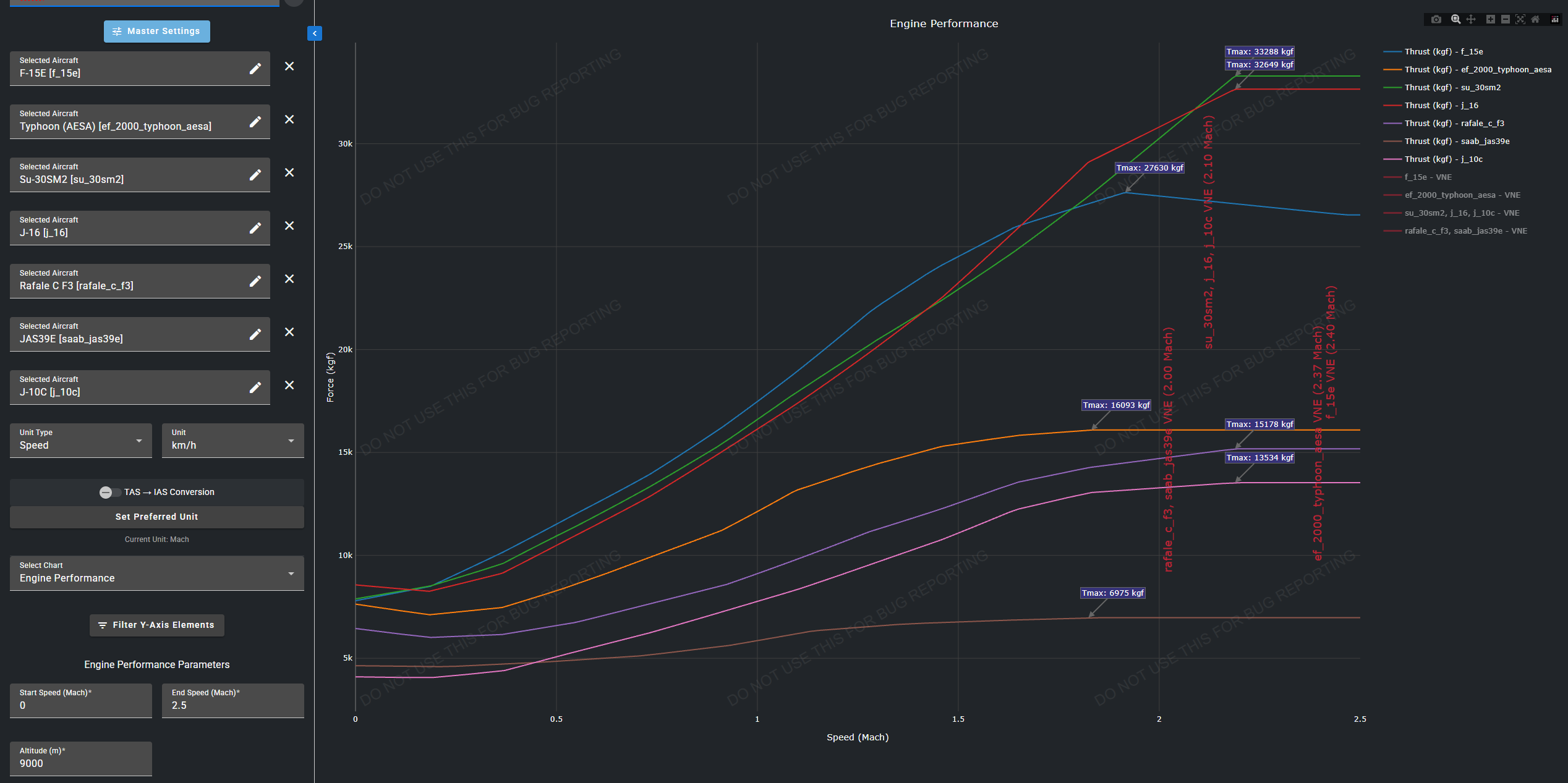
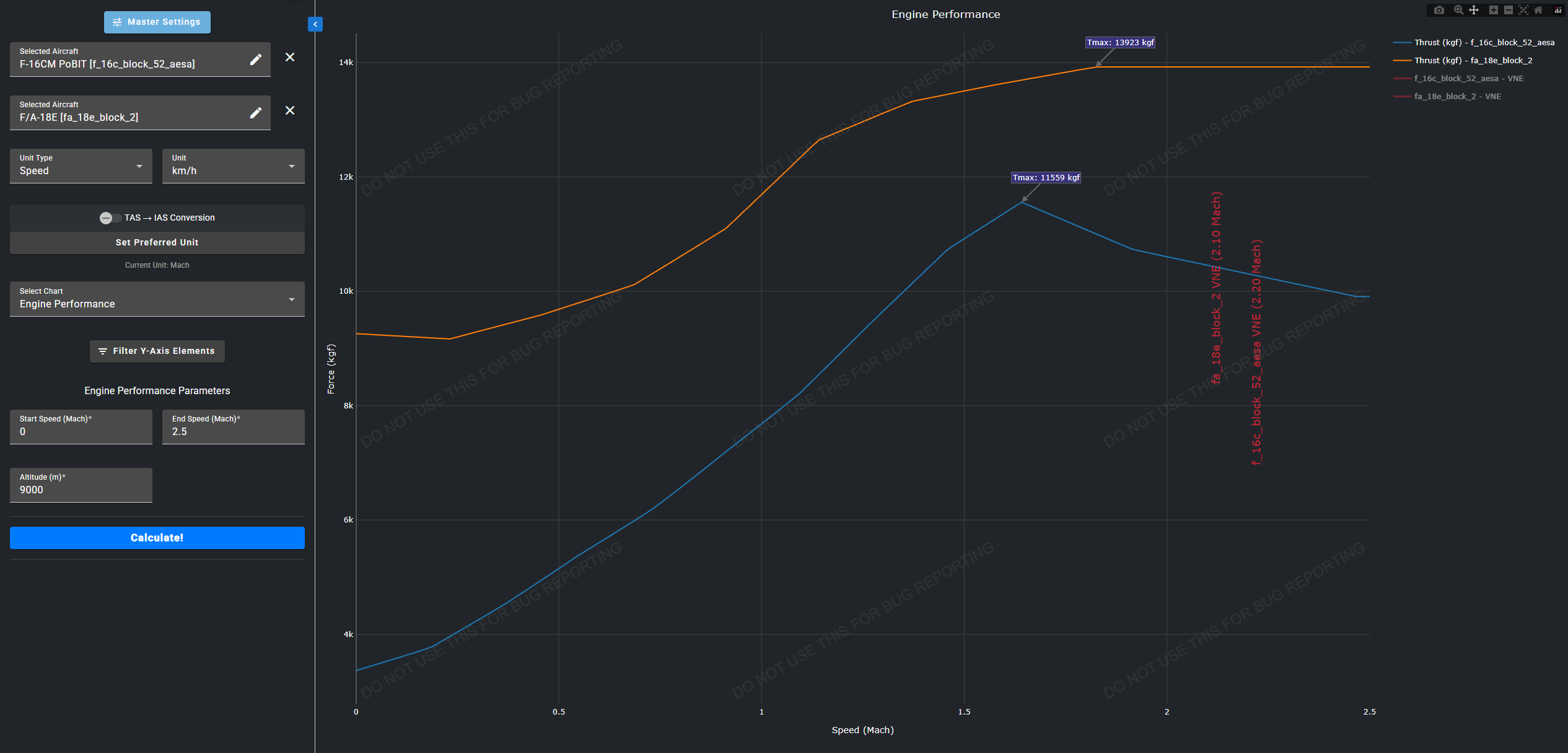
Speaking of btw, the EFT has a horrific thrust curve for top tier:
If you calculate static thrust vs max thrust (yes, a bit simplistic, but gives a general idea of the slope of each jets thrust curve);
- Su-30SM2: 4.22x
- J-16: 3.81x
- F-15E: 3.54x
- F-16C PoBit: 3.43x
- J-10C: 3.3x
- Rafale: 2.36x
- EFT: 2.11x
- F/A-18E: 1.5x
- JAS39E: 1.5x
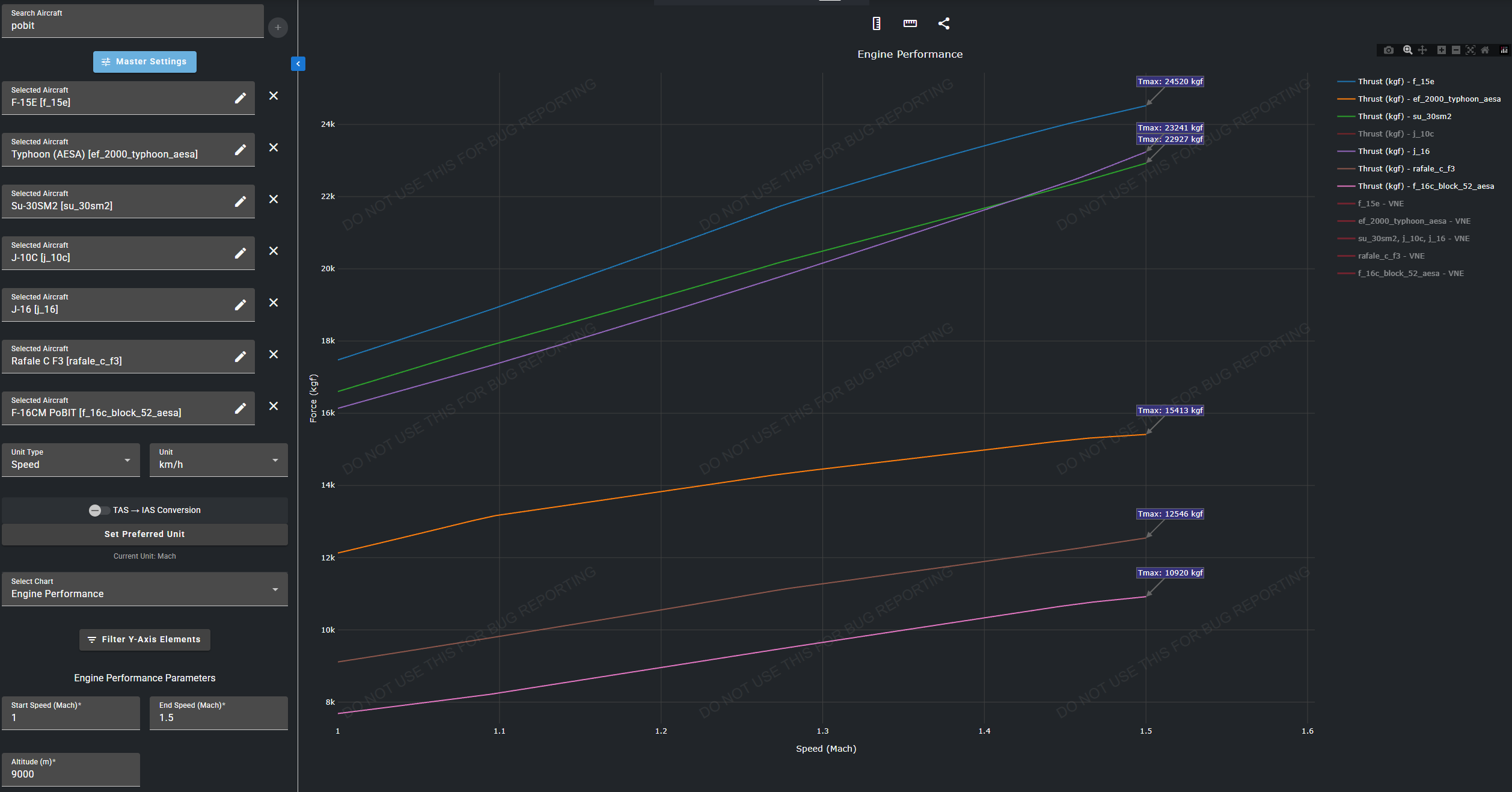
Calculating dry thrust curves from M1.0 to M1.5;
- J-16: 1.44x
- J-10C: 1.43x
- F-16C PoBit: 1.42x
- F-15E: 1.40x
- Rafale: 1.38x
- Su-30SM2: 1.38x
- EFT: 1.27x
Calculating drag curves for M1.0 to M1.5;
- F-16C PoBit: 2.33x
- Rafale: 2.74x
- EFT: 2.74x
- F-15E: 2.82x
- J-10C: 2.98x
- Su-30SM2: 3.05x
- J-16: 3.07x
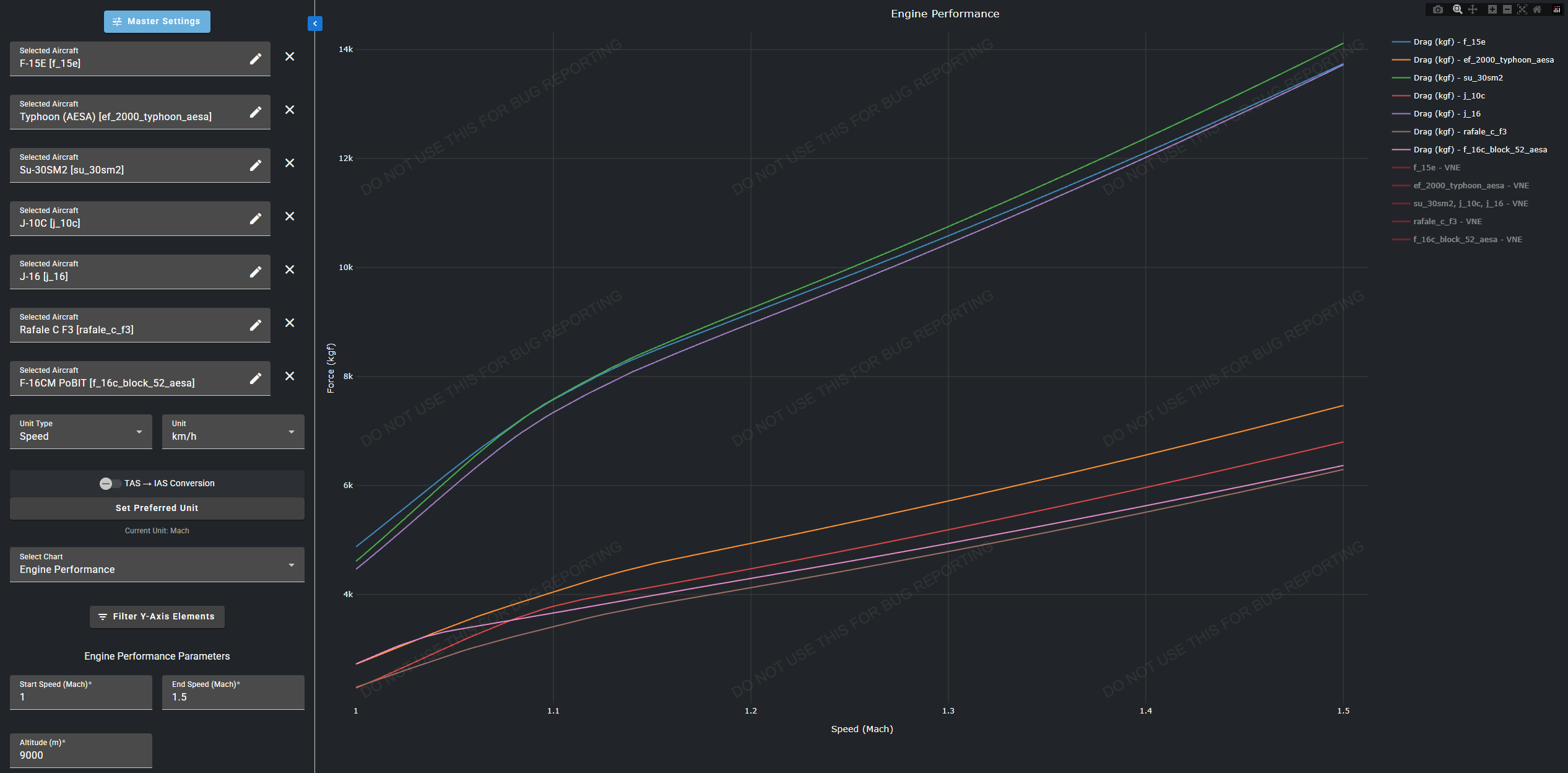
EFT has the worst thrust curve, both dry and wet, of all M2.0 capable top tier jets, while its drag curve is relatively similar to all other top tier jets, most notably being the same as the Rafales (atleast within M1.0-M1.5), despite very clear aerodynamic design decisions to minimize drag increases at supersonic speeds (more swept wings for example) compared to the Rafale. The devs are once again just lying about “unrealistically high thrust and unrealistically low air drag” being required to achieve M1.5 supercruise. Its literally just another case of the devs knowing we cant bug report certain things (either due to lacking the sources to do so, or because said things can only be found via datamines), and then just lying to our face to justify their models not fitting irl statements.
If you increased the dry thrust curve for the EFT to lets say 1.4x (middle of the pack) for example, the thrust to drag ratio at M1.5 goes from ~2.06 to ~2.28, or a roughly 10.7% improvement.
**I dropped the super hornet and Gripen from the comparison after the afterburner calcs cuz realistically, they’re designed to be on the slower end anyway
6 Likes
?
do you not see the F15E thrust curve there
you know where it actually somehow loses thrust as speed increases