I misunderstood that entire paragraph. Let me reformat.
It will be an advantage against other aircraft who may want to stealthily sneak up on the EF with their IRST as the EF will get a ping.
I think its more likely to have something attempt to use an IRST against it I agree. Not sure why it wouldn’t feature an LWS when IRST is effectively its’ hard counter by anything but an EF. I think they must just be exceptionally confident it isn’t required due to the great radar, networking, datalink and battlefield management systems etc.
Ranges for the MWS (PIMAWS)
- Type West 1 (UV/IR): Burning > 6 km, burnt out > 3 km
- Type West 2 (IR): Burning 6,5 km, burnt out 5,5 km
- 9K32 Strela-2 (IR): Burning 4 km, burnt out 0,5 km
- 9K33 Osa (RF): Burning 12 km, burnt out 5 km
- 9K35 Strela-10 (IR): Burning 10 km, burnt out 7 km
- 9K310 Igla-1 (IR): Burning 5 km, burnt out 1,5 km
source : Ingo Schwaetzer: Multiple use of an IR missile approach warning system. Proc. SPIE 5074, Infrared Technology and Applications XXIX, 10. October 2003
Ranges for the MAW (AMIDS)
There is no known ranges but it can be estimated (resoning in the spoiler)
Spoiler
The detection range can only be estimated: Since the “radome” at the rear has approximately the diameter of a seeker of an air-to-air missile, its detection range can be used as a basis. The X-band seekers 9B-1348E (R-77) and 9B-1103M (R-27AE) from AGAT have a detection range of about 10 km against a radar cross-section of 1 m². Since the directivity and antenna gain are approximately inversely proportional to the square of the wavelength, the Ka-band yields a 12.25-fold antenna gain for the same dimensions. Since this gain enters the radar equation with the square root, the detection range will be about 3.5 times higher. However, the target RCS (Radar Cross Section) also increases with higher frequency, while atmospheric attenuation reduces the detection range. Ultimately, based on the AGAT seeker family, the following detection ranges for AMIDS can be estimated:
source:
and yes i know it was about that missles in its last flight phase use LRF to target
2 Likes
now back to the actual LWS
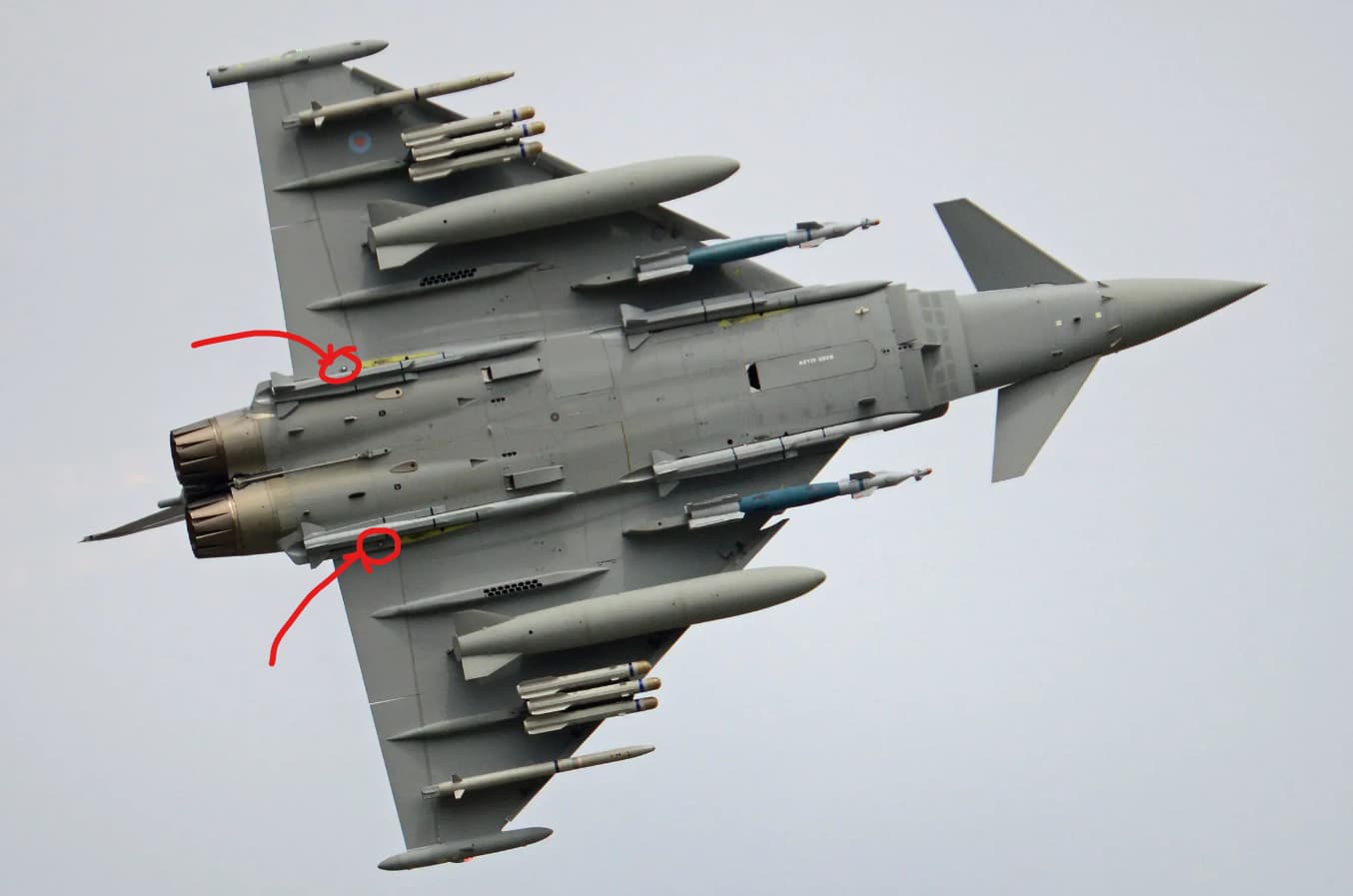
im not sure if it can properly detect the angle of the laser…
there are 6 receivers
and idk if thats enough to detect an exact angle…
1 Like
LWS is important just for situational awareness. It would be useful in Ground RB for instance, any helis that inadvertently lasered you would be picked up, and their location would be seen on RWR. Same for any SAMs that used it’s laser. It doesn’t make sense to say that if the F-35 doesn’t have it, then it isn’t that important, because the F-35 isn’t likely to be detected by radar or IRST at long ranges like the Eurofighter as it reduced radar and IR signature. So the LWS is more necessary for the Eurofighter than the F-35.
2 Likes
That’s more receivers than the RWR. Wikepdia say they can find the direction (although does not give a margin eg less than a degree). However it also says it can direct the bearing which is measured in degrees so I’d say the accuracy should be to a degree. I think for the reason they’re mounted at all, we could reasonably assume they should be accurate to a degree too.
Also says there’s only 4 mountings for the LWS system but I think thats the page oversimplification as there are 4 regions in which they are mounted but these are in 6 different mounts as your pictures indicate.
also i find it weird that EuroDASS doesnt list the LWS on their website
1 Like
This is for the F-35 isn’t it?
I think its because its an add-on, but it is odd and I have no idea.
F-35 is DAS. Eurofighter is DASS and the MWS specifically was the AMIDS. there were multiple bids to make the MWS and this was one of them
1 Like
Now i’m confused whats the difference between the MWS and the MAWS?
Missile Warning System
Missile Approach Warning System
same thing, different acronym
yeah ik its not complicated enough
1 Like
That explains it, I knew what they meant but couldn’t figure out how the systems could possibly be different. Cheers.
btw the German EuroDASS wikipedia article incorrectly states that the Spanish Eurofighters have the LWS. they do not.
The Spanish Eurofighters do however have the same panels as the EFs with LWS but they dont have the actual receivers installed.
Its a modular aircraft and they chose this because it would be cheaper to equip the LWS if they needed it.
1 Like
Its essentially a different article in German and in English, damn I need to use German wikipedia more there’s waaay different information. I wish my pc would stop trying to translate the german for me though because 50% of the time its just wrong.
So i found out more
The AMIDS has its sensors in each wingroot and the probe in the back
The PIMAWS is another passive system added to the wing pods giving it 360° coverage
Spoiler

1 Like
oh it was Diehl Defence ^^
wow there’s a hole paper
Wayback Machine (archive.org)
Now its interesting that they put this on the DA1 because that one had some other stuff in the ECM pods(i think they’re cameras because there’s windows facing towards the aircraft… probably to monitor fing flex or smth)
ok now i want to see that being put onto modern EFs in addition to existing systems… absolutely rad that it can work as an IRST
2 Likes
Espacenet – search results
Espacenet – search results
BAe patents for detecting the range of an rwr contact
so ig the DASS can estimate range as well…
Wayback Machine (archive.org)
brochure for the towed decoy