I forgot to mention that part, and will include it, yes it has commonalities which significantly reduces the costs of both missiles but it isn’t known what exactly those commonalities are, atleast not from the two sources I linked.
I assume probably the seeker and warhead and some other things
1 Like
Yeah I’d assume seeker, warhead, datalink, and several other parts. The Brits also intend to make the Stratus-LO compatible with the F-35 as well. It’s already a big boy so it would be interesting to see how it fits within the bay.
No seeker is different, RS is radar, LO is IR.
But otherwise i don’t think the LO is inefficient in every scenario, i remember that the conclusion of wanting more a missile like RS compared to LO is because there were test at the marine nationale level, and overall you are better with a really fast misssile to reach a sea target than one which is subsonic.
So for France LO is fine in a SEAD context but against ship it is not enough.
1 Like
That makes sense i guess
Do you have any source for that? I mean for the LO.
H i guys I was wondering do we have some number for power in KW of the RBE2 AESA or nah, thx ya ?
9.6kw for the RBE2-AA’s peak power.
2 Likes
The RJ 10 will feature a radiofrequency seeker, while the TR 15 will have an imaging infrared one.
RJ10 = Stratus RS,
TP-15 = Stratus LO
they did a little mistake when writing the article but well.
1 Like
Thanks. EDR magazine is also the only source I’ve seen that claims flight testing could be done as early as 2026
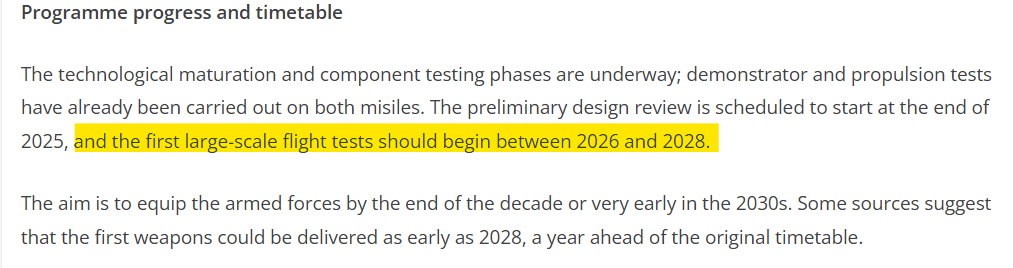
PAS 2025 - FC/ASW: European new generation missiles developments - EDR Magazine
1 Like
I would tend to agree, was great in the 80s and 90s but it’s getting really old now.
Well I can only hope it will be as maneuverable as portrayed in that clip
Possible connections on hard points as well as a few internal components like the warhead ?
Other than that afaik the seekers are different as specified by @_OceanFish
1 Like
I would agree, I should say insufficient to the French’s specific design requirements. The Stratus-LO is just a different way of accomplishing the same goal for the Brits and they placed their bets that stealth wins out more than supersonic, only in actual wars will time tell and hopefully we never get to that point.
Apparently the Americans went with the LO route instead of supersonic, so the Brits aren’t the only ones that made that conclusion, it’s possible the Brits conducted studies and tests of their own and got to their separate conclusion as well.
1 Like
Thx, do you have sauce/ link maybe ?
Impressive for such a small radar
Considering SCALP already uses both guidances (radar for terrain mapping, IR for terminal guidance), it’s possible that the 2 missiles use multiple guidance systems with some commonality. Especially if they are to be used against moving target (like a boat) at ranges greater than a few dozen kilometers
I will ask Mulatu if I can share his source, he found it so it will depend on his answer. I’ll update you soon hopefully.
Interestingly, RBE2-AA on Rafale F4.2 goes up to 14kW peak power because GaN is incorporated. Unfortunately radar power is not bug-reportable, and average power is probably far more useful as well than peak power.
1 Like
Source is speculating on the seeker part and is likely outdated as it’s from 2018, but it does discuss something like what you said.
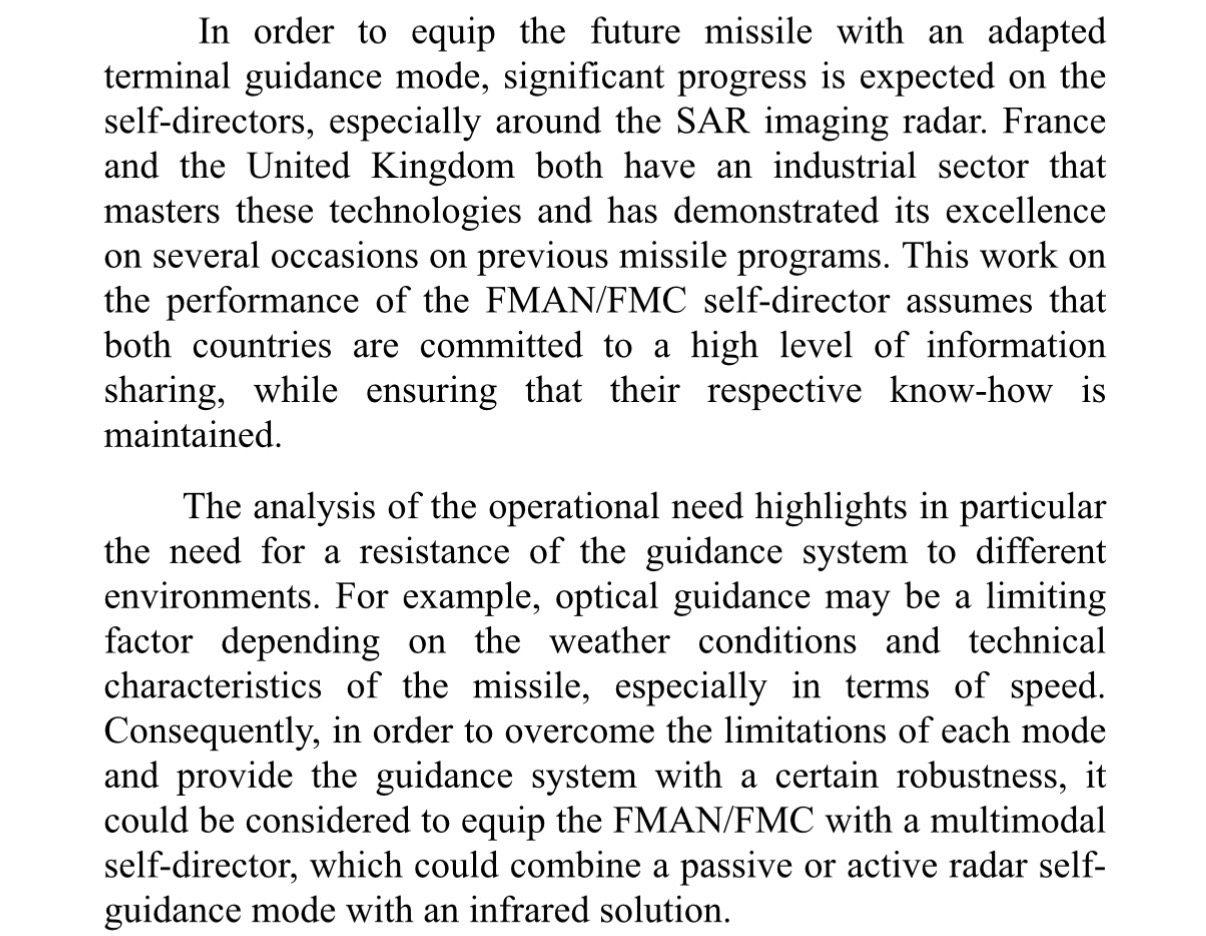
Where does that come from ?
I’ve yet to see any credible Source myself, let alone any mention for sich plans from Dassault / French Gov; as “GaN” for RBE2-AA has been a thing in media since 2014, other saying its a thing since F.4.1, even though there is sign it was ever done.
For F.4.2 there is “GAN” mention, but thats related to Carrier Strike Group communication.