Avoiding Future Mistakes: A Logical & Balanced Roadmap for 5th-Gen Stealth Aviation US & Other Nations

YF-23A PAV-1 lineup after F-15EX (A repeat of the Mirage 4000 and Yak-141 situation, the most sensible and sober option, it is also logically connected with later proposed FB-23)

F-35B Block 3F lineup after EA-18G (AV-8B Plus lineup, The aircraft has been accepted for consideration by the developers and brilliantly fills a wide gap in combat rating between the AV-8B Plus and the F-35B, like an interesting SEAD/DEAD jet Which has full access to air combat, it have AN/APG-79 with Aim-120D and Aim-9X Because they are built on the basis F/A-18F Block 2)

F-35C Block 3F lineup after F/A-18F Block 3 Boeing TD (Block 3 demonstrator has a better cockpit, access to CFT, Enclosed Weapon Pod, Aim-260, 424 and 174, while the current F/A-18E Block 2 will be able to fly with the Aim-120)

F-35C Block 4 lineup after F-35C Block 3F ( Block 4 has access to AIM-424/260 to create balance and more noticeable differences, Also, at least for now, the naval version is the only one that has been confirmed in terms of equipment Aim-424)

F-22A Block 30 lineup after F-15C Golden Eagle
F-22A Block 40 in lineup after F-22A Block 30 (Has access to AIM-260 and IRST with new cockpit and DAS MAW)

F-35A Block 3F lineup after F-16CM Block 52 PoBiT
F-35A Block 4 after F-35A Block 3F in lineup (Block 4 access to AIM-260 to create balance and more noticeable too)

YF-22A PAV-1 in premium (An interesting machine without a helmet-mounted target designation system, with variable-cycle GE-YF120 engines and extremely serious differences compared to the serial one F-22A)

X-35B in squadron (Free players without a leveled up branch will be happy to receive a unique stealth prototype with vertical takeoff, and will not be left out)

X-32 in event (An extremely noticeable, unusual in appearance Boeing prototype for JSF program, It will be extremely well suited as a noticeable and unusual aircraft for an event and a collection that no player can pass by)

F-15SE in premium/event (can become premium instead of the YF-22, or right before it. An interesting aircraft with flight characteristics of the level F-15EX, but with an internal number of missiles without the use of external suspensions like a 4x Aim-120. Attempting to simulate stealth on a redesigned 4th generation airframe is an important step towards implementing the RCS mechanic in future)

B-2 in event like a B-52H (An impressive and iconic machine that won’t fit properly in lineup, but may become the main figure of a special event for her and her competitors from other countries in the future)

Why the YF-23 Belongs in the Tech Tree (and Nowhere Else)

I originally came up with this roadmap while thinking about the role and placement of my personal favorite aircraft - the YF-23 PAV-1. Time and again, I’ve seen players demand that it be added as a premium, event, or squadron vehicle, claiming that putting it in the regular tech tree makes no sense. I strongly disagree.
Among all the fighters ever built, the YF-23 is truly one of a kind. It offers extraordinary climb rates, phenomenal energy retention in sustained turns, and unmatched high-altitude interception capabilities with massive effective range. Beyond its radar stealth, people often overlook its superior infrared and ultraviolet low-observability - achieved through its buried engine layout and shielded exhaust troughs - as well as its refined aerodynamics that minimized transonic wave drag and shockwaves, making it much harder to detect visually or acoustically.

An aircraft that represents such an apotheosis of engineering - easily standing shoulder-to-shoulder with the F-22A - belongs in the main research tree. It is the exact kind of iconic machine that motivates players to grind down a line with genuine excitement and determination.
And that brings us back to the main question: if it goes into the tech tree, where should it sit, and what takes its place in the premium/event slots? The roadmap above answers both questions. If Gaijin wastes the YF-23 on a premium or event slot, there will be nothing left to put in the tech tree after the F-15EX without resorting to unbuilt paper projects like the F-23A EMD proposal. Meanwhile, machines like the YF-22 PAV-1, X-35B, and X-32 fit those special roles far more naturally.

Balancing Considerations & Community Poll

You may disagree with me, and that is completely fair. However, I strongly believe that introducing an aircraft like the YF-23 should not be reduced to just another $80 premium pack, a squadron vehicle like the Su-33, or a time-limited event reward like the F-14A IRIAF.
From a gameplay and balance standpoint, the YF-23 is a very specific machine that will actually be quite challenging to fit into the future top-tier meta. It comes with clear historical limitations: a smaller internal missile load of 4× AIM-120B and 2× AIM-9M (which will naturally fall behind the AIM-120D and AIM-9X carried by production 5th-gen fighters), the open question of whether its planned 20mm M61 Vulcan cannon should be modeled, and an early prototype cockpit borrowed largely from the F-15 (and F/A-18). Because of these trade-offs, it fits far better as a unique, specialized tech-tree capstone after the F-15EX rather than an overpriced premium or an unobtainable event trophy.

I would love to hear your thoughts on this. Where do you think the YF-23 PAV-1 belongs in the game? Let me know in the poll below!

  • Tech Tree after the F-15EX (following the Yak-141 / Mirage 4000 precedent - the most logical choice)
  • Event Vehicle (similar to the F-14A IRIAF or Kfir C.10)
  • Squadron Vehicle (similar to the Su-33 or F-117)
  • High-Tier Premium Pack (similar to top-tier pre-order jets)
  • Should not be added at all (stick strictly to production 5th-gen fighters)
0 voters

If you’d like to discuss a similar roadmap for other nations’ tech trees, let me know in the comments! I’d be happy to put together a follow-up post for the USSR/Russia, China, or European aviation trees-especially since this placement logic also helps clarify how and where specialized counterparts like the J-16D (and other unique 4++ and 5th-gen prototypes) should fit into the game. I’m all for a fair, well-reasoned placement of every nation’s cutting-edge aircraft, and I’d love to hear thoughts not just from US mains, but from players across all nations.
1 Like

It might seem like this post is focused on just one aircraft, but I really don’t want it to come across that way. What I truly want to discuss with you is the bigger picture: how iconic machines earn their place in the game, what determines their position in the tech tree versus special slots, and what principles both players and developers should follow when shaping the future of top-tier aviation.

1 Like

First off, I really like the proposed options here. It’s nice to see that, at least for some nations, 5th gen aircraft could fill out our (for the time being) final rank quite nicely, rather than being stuck with just 2-3 options.


Only thing I’m a bit torn on is things like the YF-23, YF-22, X-35 and X-32. I don’t mind these aircraft in general, but I am a bit worried about the implementation these would have, since in reality all of these were unarmed test aircraft.

Basically what I am worried about is that these could be added in fictional configurations. By this I don’t just mean that they weren’t built / completed, but that they would be set up in a way that was never intended.

What makes a configuration "fictional"?

Since anything that wasn’t built or completed is sometimes labelled as fictional, I think I should explain what I mean when I say “fictional” and “real” here:

What makes a configuration “fictional”?

  • A component (e.g. radar) was never fitted to the aircraft.
  • There was no built-in provisions to fit said component at a later point in time.
  • There was no intent on retrofitting the component, including the necessary modifications
    → If all the above is true, that component on the aircraft is fictional

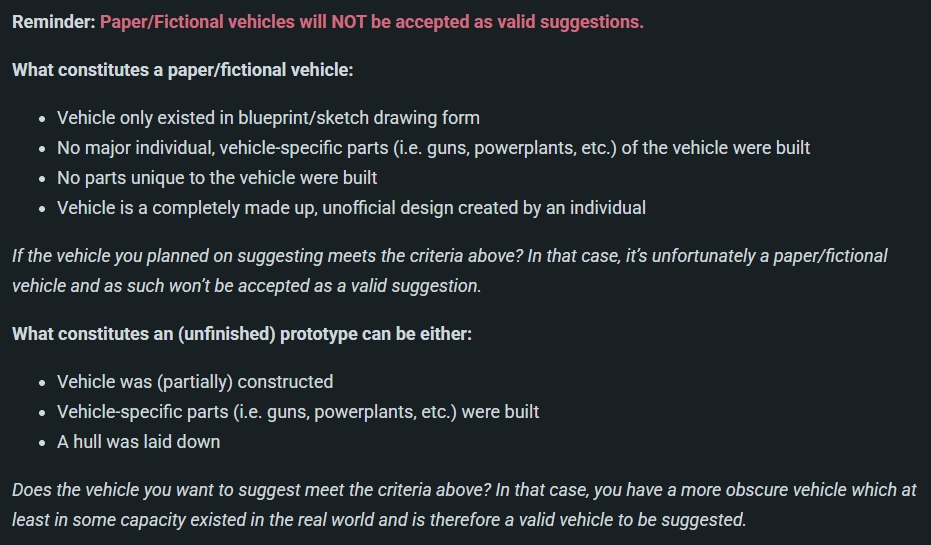
However, I personally do support the concept of “incomplete prototypes”, which are currently the standard needed for consideration* to be added to the game, and directly enforced by suggestion guidelines.

*

*Consideration doesn’t mean something is automatically added, just that it isn’t immediately disqualified. Other factors like missing information or a simple lack of need can still get in the way.

What is an "incomplete prototype"?

image_2026-11-21_221408276

Taken from the official suggestion guidelines


So to get back on the topic, if these had provisions / intent to fit systems like radar, countermeasures, RWR and live missiles, then I don’t think any of these would be problematic and would really like to see them in game.

However if some or all of these are missing from an aircraft I wouldn’t support them simply making things up, which could leave them in a weird spot for balancing. If this makes the real aircraft impossible to balance, I think it’s most reasonable to replace them with the intended final combat aircraft.

What would that mean for each of these aircraft?
  • YF-23 → F-23 (as “unfinished prototype”)
    → While the F-23 itself does not technically meet the criteria for an unfinished prototype, instead remaining a paper aircraft, they might consider this compromise as the closest to a real combat capable YF-23. A somewhat similar precedent is the Kikka, which is actually the never-built Kikka Kai in game since the variant that was built would not have cannon armament, as well as weaker engines.

  • YF-22 → F-22 (skipped)
    → Since the F-22 is a complete aircraft already, an unfit YF-22 would simply be skipped.

  • X-32 → F-32 (as “unfinished prototype”)

  • X-35 → F-35 (skipped)

If you know more about these aircraft than me, and I think you probably do, some more info on what they were equipped with and what they had provisions for that’d be really nice to see.


But this is a really nice write up and I do agree that having more unique techtree options is really important, especially since the US otherwise relies quite heavily on mass-exported F-35A/B that can be found in the air forces of most other nations in game, seeing something like a YF-23 or X-32 would make the techtree as a whole more appealing.

As long as these aircraft can be faithfully represented in game, I’d like to see them all eventually.


These would be really interesting to see as well.

I mostly just looked into the Japanese options myself, and it’d be really nice to get some insight into the lesser known options there is for other nations that I don’t actually know much about. For example the many variants of Chinese 5th gen aircraft, Russian projects and even things like EADS Mako (Germany/Italy) or BAE Replica (UK) that I know were being developed but don’t actually know how far these went.

2 Likes

Fair point-adding pure “paper” setups isn’t ideal. However, just like the Yak-141 in-game (which flew trials with ballast in place of its radar and weapons), all four demonstrators had dedicated internal bays, flight-tested engines, and AESA hardware undergoing concurrent flight and ground range trials during their respective Dem/Val programs

General

YF-23A PAV-1 (s/n 87-0800)
Engine: 2× General Electric YF120-GE-100 (variable-cycle turbofan, ~35,000 lbf class)
Radar: Westinghouse / Texas Instruments ATF AESA (~1,500 GaAs T/R modules, AN/APG-77 prototype)
Armament: 4× AIM-120A + 2× AIM-9L/M (single central internal bay) + internal provision for 1× 20mm M61A1/A2 Vulcan

YF-22A PAV-1 (s/n 87-0700)
Engine: 2× General Electric YF120-GE-100 (variable-cycle turbofan, ~35,000 lbf class)
Radar: Westinghouse / Texas Instruments ATF AESA (~1,500 GaAs T/R modules, AN/APG-77 prototype)
Armament: 4× AIM-120A (main bay) + 2× AIM-9L/M (side bays) + internal provision for 1× 20mm M61A2 Vulcan

Boeing X-32A (s/n 00-01)
Engine: 1× Pratt & Whitney F119-PW-614 (JSF119-614, ~37,000 lbf class)
Radar: Raytheon JSF AESA (GaAs T/R modules, direct predecessor to AN/APG-79)
Armament: 6× AIM-120C (3 per side bay) / 2× AIM-120C + 2× 2,000-lb GBU-31 JDAM (internal) + 2× AIM-9X (wingtip pylons) + provision for 1× 20mm M61A2 Vulcan

Lockheed Martin X-35B (s/n 301)
Engine: 1× Pratt & Whitney F119-PW-611 + shaft-driven Rolls-Royce LiftFan (29,000 shp drive shaft, ~18,000 lbf cold thrust) & 3BSM swivel nozzle
Radar: Northrop Grumman MIRFS JSF AESA (direct predecessor to AN/APG-81)
Armament: 4× AIM-120C / 2× AIM-120C + 2× 1,000-lb GBU-32 JDAM (shortened internal bays) + 2× AIM-9X (wingtip pylons); no internal gun

Documented Test & Hardware Basis

Engines (Flight-Tested on Airframe):
YF-22 PAV-1 (first flight Sept 29, 1990) and YF-23 PAV-1 (first flight Aug 27, 1990) both flew with GE YF120 engines at Edwards AFB (PAV-2 airframes of both designs used P&W YF119 engines).

X-32A (first flight Sept 18, 2000; 66 flights total) flew on the P&W F119-PW-614.

X-35B (converted from X-35A s/n 300; first STOVL hover June 23, 2001; Mach 1.07 STOVL mission July 20, 2001) flew on the P&W F119-PW-611 with the Rolls-Royce LiftFan.

Radars (Concurrent Flight & RCS Range Trials):

During flight trials, prototype nose cones housed telemetry and ballast matching the exact mass and CG of the respective AESA units.

ATF Array (YF-22 / YF-23): Flight-tested by Westinghouse / TI aboard their BAC 1-11 (N164W) avionics testbed in Baltimore, MD in 1989-1990 alongside the Common Integrated Processor (CIP) before becoming the AN/APG-77.

X-32A Array: Raytheon’s JSF AESA aperture, radome, and EW/CNI suite were mounted and tested on Boeing’s Full-Scale Pole Model at the Boeing Compact RCS Test Range in Seattle starting March 2000. Following the October 2001 JSF decision, Raytheon transitioned this architecture directly into the F/A-18E/F’s AN/APG-79.

X-35B Array: Northrop Grumman’s MIRFS array underwent airborne testing on Northrop’s BAC 1-11 testbed in Baltimore prior to entering EMD as the AN/APG-81.

Weapons Bays & Live Ordnance Trials:

YF-22 & YF-23: Sized for the 25-inch-span AIM-120A (the cropped 17.6-inch-span AIM-120C did not enter service until 1996), limiting the YF-22 main bay to 4× AIM-120A instead of six. In Nov-Dec 1990 at China Lake / Edwards AFB, YF-22 PAV-2 executed live internal bay launches of both an AIM-9M (at Mach 0.7 / 20,000 ft) and an AIM-120A.

X-32A: Equipped with functional side-mounted bays; on January 26, 2001 (Flight 61) at Edwards AFB, it flew with an instrumented AIM-120 and JDAM installed and cycled the bay doors in flight to record acoustic and structural vibration loads.

X-35B: Internal bays were shortened around the LiftFan ducting, retaining full length for 4× AIM-120C (143.9 in) while restricting internal bomb loads to 1,000-lb GBU-32 JDAMs (vs. 2,000-lb GBU-31s on X-35A) and omitting the internal cannon for STOVL weight limits.

w97ysgn9kkqd1

Boeing X-32A internal side weapons bay during its 61st test flight at Edwards AFB (January 25, 2001), carrying an instrumented AIM-120 AMRAAM and a JDAM.
Source: Official Boeing press release / Boeing Images Archive

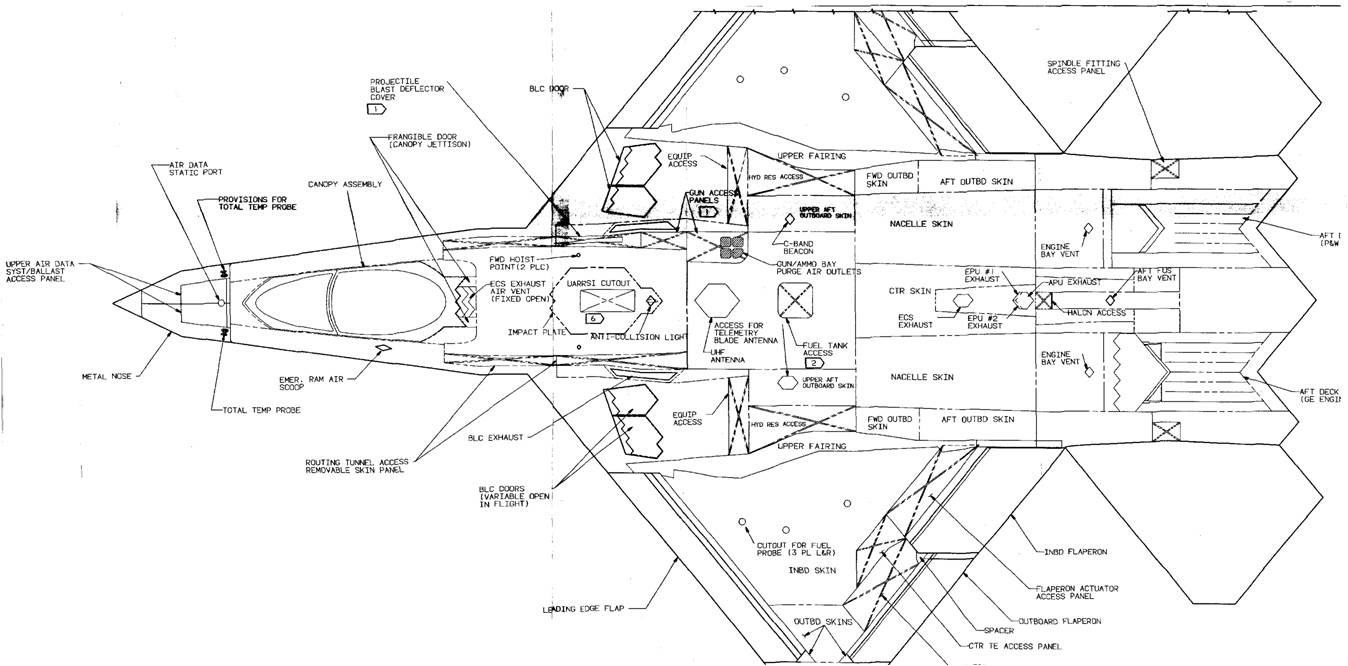
Northrop/McDonnell Douglas YF-23A top-view access panels, sensors, and airframe layout diagram (1990). Shows locations of gun access panels, UARSSI cutout, antennas, BLC doors, and engine/APU vents.
Source: Northrop Corporation ATF technical documentation / YF-23A Utility Flight Manual (NTM 1F-23(Y)A-1)