Disregard what I wrote then, my translator’s not the best.
Perhaps, though between some assumptions (like I doubt they’ll be usable past 30km) and the brief explanation of what ARMs are going to look like from the Q&A, I think half of that is going to be irrelevant.
I think the factors of greater impact will be:
- What ARMs can be used against which SAMs (if that is even modeled)
- How many ARMs can be carried (perticularly important at higher BRs with mass missile interception)
- What needs to be given up to enable carrage of ARM
To that end, Im thinking one of the stronger may be the Tornado GR1/GR4 simply because it can carry a boat load of ARM, including 2 ARM no matter what the loadout and can operate at a BR where hopefully it wont see the top SPAA, especially the new Pantsir.
We shall see, if BRs stay the same, the Tornado might be better BR-for-BR.
Does anybody perhaps have a source on the flight profile of the KH-31P? From what I can read it has a 110km range, but only at very high altitude (Maximum launch range (at H=15 km) = 110km). Minimum launch height seems to be 100m, but I doubt the missile would reach it’s operating parameters at such low altitude, the solid rocket booster needs to propel the missile to sufficent speed allowing the ramjet sustainer to operate.
1 Like
Yes. And you have launch speed range. So ramjet can work if you launch Kh-31 on 100m on 650km/h
1 Like
While the 58UShk is definitive on it’s bands, I’m still curious on a proper answer about 31PD… closest thing is from those Zhuhai and what you sent saying it’s “similar”…
Still beats trying to locate the at least 5 different seekers made for Kh-58U…

With the day of reckoning and headaches upon us, I thought I’d just say that if anyone has any proper sources/info on ARMs (mainly about their seekers) and are willing to share, please do! ^^
1 Like
What are everyone’s thoughts on ARMs now that we have a taste of them.
Against AI the AGM-88A seems to have a very high interception rate at the subsonic speeds of the intruder/crusader.
They don’t seem to change that much. Maybe it will be different once more jets get them and GRB CAS players get their mitts on them.
The problem of ARMs in GRB is that you lose your ability to take out more valuable and important targets, I can see them working at very specific BRs but at top tier, not so much… Russian teams would not even need them as they already have Kh-38ML/MT. It will be a novelty weapon for sure, I don’t see them being that popular or game changing.
1 Like
At top tier the CAS isn’t going to get to any targets if the AA is overly oppressive. You’re right about these being an almost useless missile for nations with access to the Kh-38. Nations without the supersonic capable A2G missiles will get a boost from these.
I just tested the russian HARMs since the jets that can carry them are capable of supersonic.
Under supersonic: almost all are intercepted
Over supersonic: almost all get through within ~10-20km
Seeing how these perform on a F-15, F-16, F-18 or other nations jets will be interesting.
1 Like
This is where the Tonka GR1 and GR4 could be really solid. You can always take 2, without affecting the rest of your loadout
As they are in the game, you can still get aa kills with subsonic ARMs provided you offer yourself up as a target and use countermeasure or happen to have a teammate that distracts the AA system while the missile goes for the kill.
They are coded kinda like tv guided missiles, except they don’t care about weather, can lock from very long ranges and can loft to the target, so i can see some use cases against player controlled aa that isn’t all knowing. They would be a LOT more useful if they had IOG and you could send them at a specific spot marked on the map or the targeting pod, right now they might as well be broadband shrike missiles.
There are some nations that could really use them though. For example, Italian tornados currently have no long range missiles, at the most we have GBU-39s which are slow GPS-only glide bombs. This would give amazing utility at that BR range against all these SPAAs and let you take them out so you can get closer to use your LJDAMs etc. in fact, Italy does not get a single AGM aside from the MCLOS Nord AS20/30 until you hit the 12.0 Harrier II
Yeah, that’s why I said they would be useful at some specific BRs, especially ones where some aircraft have no viable AGMs, it will definitely be a win for Tornados. I can’t wait to try HARMs on them.
1 Like
Sometimes youtube comments go above and beyond in terms of quality.
@xyz-hj6ul
The AGM-78A was an interim model because the AGM-45 Shrike seeker it was fitted with was so lacking in capabilities, being a fixed seeker, fixed band, system that was both limited in the emitter types it would home on via individually tuned heads and difficult to reprogram while having no ability to exploit the STARMs full kinematic range.This was because its acquisition cone was so narrow that any deviation in trajectory would take the missile out of acquisition parameters (the seeker also would not lock-on beyond about 8-10nm vs. the STARM’s 25-30nm missile direct mode and 55-75nm lofted envelope).
The later AGM-78B/C/D had a radio frequency memory that was amenable to easy field reprogramming and allowed multiple pre-tuned emitter types to be locked onto in a given mission.
More importantly, on the later ‘Maxson’ seeker models, the head itself was a gimbaled dish rather than a fixed spiral heterodyne type system and so could track the target to 60-70
off boresight. Once locked, and 'remembered', the missile could be fired 180off boresight against the target and would turn to engage.This meant that the Weasel pilot did not have to point the jet right at the radar to launch against it, which was the primary method which the Vietnamese SAM operators used to know when to dummy load the Fan Song or Fire Can radars and defeat the ARM. They did not track the <.1m2 radar signature of the inbound missile, they observed the behavior and radio chatter of the parent jet/s which fired it.
The AGM-78, being based on the RIM-66 naval SAM, had a fairly sophisticated autopilot and would fly to given 3D coordinate set based on ‘last signal’ logic from the space-stabilized seeker head pointing index.
The 462lb Shrike’s fixed antenna meant that it rode the beam and while it could lock onto targets after launch, because of its short motor burn, had to be fired in a manner which let the missile antenna intercept the radar beam at a specific dive angle after a lofted parabolic arc.
None of which was indicated to the pilot directly but instead required significant head math to match parent fighter dive angle on the ADI, to greatest seeker signal strength (via audible tone in his headset) and then guestimate resulting pitchup to launch angle vs. achieved range trigonometrically, lofting the AGM-45 so that it fell into the radar primary lobe.
As the table below indicates, a HUGE amount of Shrikes were wasted this way.
The AGM-78B/C onwards could do all of this, range/bearing calculation, automatically, simply by selecting the target strobe you wanted the seeker to look at and tilting it’s seeker head.
As stated, the 1,370lb Standard ARM also could be lofted to about 75nm and had the extended motor impulse and higher top speed (Mach 2.5 vs. Mach 1.8) to reach intermediate ranges of 25-30nm fairly quickly and so could stay in the primary threat radar cone all the way to target during most engagements. As the Vietnamese never actually searched with the Fan Song but instead used other radars (Tall King etc.) to cue site activation, reaction time of the weasels to popup threats was critical but the full range of the AGM-78 was seldom needed.
The gimbled seeker and autopilot memory function thus meant that the STARM could engage from a range and angle off which was either beyond the distance at which the SA-2 Fan Song radar could see the EF-105F/G or which caused the NVA crew to treated the neutral closure rate of the observed Weasel as a ‘no-threat’ track.
Lastly, the AGM-78 had a dorsal mounted repeater antenna which sent a copied signal of what the missile seeker was looking at to the Weasel’s RHAWS (APR-35/36) intercept gear atop the threat radar’s own signal. This showed up as a unique double-strobe visual signal modulation on the threat warning scope so that the EWO knew that the missile was still homing, and on which target.
Since many of the STARM engagements were preemptive, beyond visual range, on the target, and it was often too dangerous to close on and assess target impact via the smoke marker (which was red not white btw.), the missile beacon became the primary indicator that the weapon was homing on the correct target and that it had fused on that target (moving radar antenna, above ground level = doppler) with either the radar or alternative optical (laser) fuses.
BIA or Bomb Impact Assessment (BDA is what the recce jet or drone verifies from an overhead IMINT pass, post strike) occurred when the beacon transmitter sent a further pulse modulation upon warhead detonation, as both primary threat radar and repeater augmented signals hopefully vanished, simultaneously. Or only the missile’s did.
The Red Smoke flare was a target marker for a miss, it did not indicate a hit.
SEAD in Southeast Asia was exactly that, hit or miss, as an attempt to get the enemy radar to recuse itself from the fight.
The following tables are from April to October of 1972., the height of the Freedom Train and Linebacker, high intensity, efforts in the third, final, phase of the airwar-
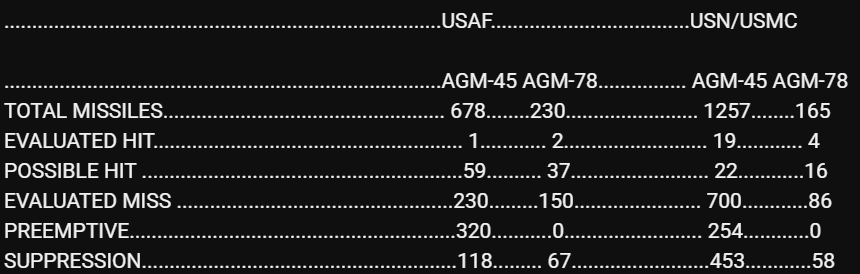
This was important because, the threat density over Route Pack V/VI was incredible, not having been attrited since 1968. And thus, standoff shots into a very densely cluttered RF environment, with multiple hostile radars, was the norm. With the cheap and cheerful Shrike, this was done by ‘showers’ of ARM, lofted to the full 17-21nm of range possible with the missile (SA-2 was good to about 19 so there was some overlap). With nearly half of them missing or lost.
But STARM was too expensive for that and while the weapon would always wardet (to protect the GCS electronics assembly from exploitation) at the end of its flight time, as missile speed slowed; as when the missile was fired blind or from significant off-axis angles in prebrief or command modes, you typically could not see the target smoke marker, whether due to slant range, time of day or intervening cloud layers.
Thus, it was not always clear which emitter in a densely populated signals environment was being looked at or had been taken off air, even with the narrow-band, pre-tuned, Shrike seeker of the A-model STARM.
The beacon on the subsequent AGM-78B/C made a secondary engagement decision easy to make, from the moment of launch, as the beacon pulse matched the radar pulse, on the video display. And thus Weasels did not have to wait for full flyout of the initial missile to see which radar blinked-off using a shoot-look-shoot decision cycle. The STARM would continue blipping even as the strobe from the site died away, as when the crew dummy loaded the radar.
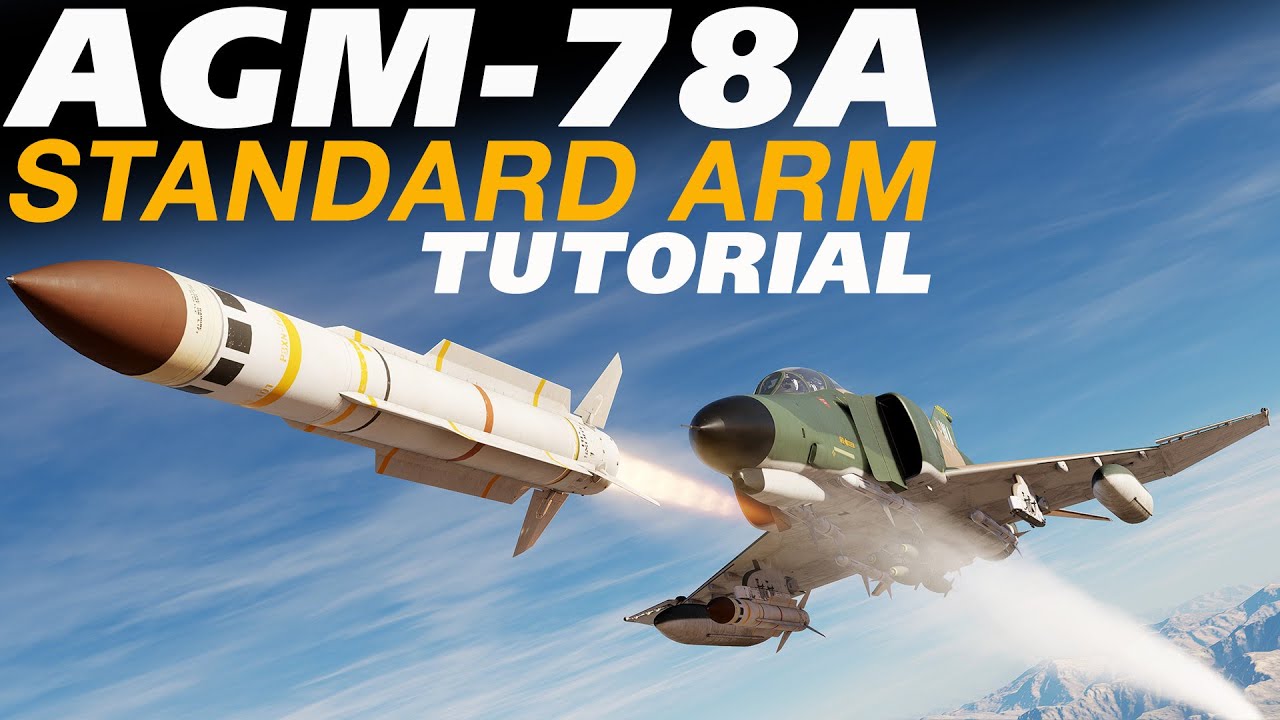
AGM-78A was, frankly, only a very small improvement over the AGM-45 and because it used the same antenna system and autopilot guidance, was not compatible with the later, ‘digital’, STARM interface used on the AGM-78B/C/D which also became the defacto missile communications architecture for the LAU-118, talking to the early AGM-88 HARM.
As a result, AGM-78A was only used on the EF-105F model and AGM-78B/C on the F-105G (during the Vietnam War), while the AGM-78B/C/D were available for the F-4G and A-6B/E, as the AGM-78A was quickly converted to C standard.
No model of the F-4 (EF-4C, EF-4D, F-4E) used the STARM in combat in SEA. It was a weapon reserved for the F-4G Wild Weasel conversion which was available from 1978 onwards, post war. The IDFAF did employ the missile, extensively, in the 1982 Bekaa Valley War on a pair of F-4Es which were converted to nearly F-4G standards. As well as (predominantly) from ground launchers chasing repeater augmented scout and mastiff drones which the Syrian SA-2/SA-6/SA-8 locked onto.
@bjornsmith9431
The F4C phantom in the USAF was used as a wild Weasle platform September 1972 Linebacker I and II campaign in the Vietnam War, the primary two Antiradation AGM 45 missiles semi memory or limited memory, two sparrow missiles and two sidewinders air to air missile defense. There was a case in Linebacker 2 of an F4C Weasle fighter after destroying SA 2 S.A.M site with AGM 45 engage a MIG 21 long range with it two Sparrow AIM 7 missed the pilots decide to used the last AGM 45 shrike the missile missed the MIG 21. I wonder if the AGM 78 B or C would be better with full memory and card gimbal guidance in the air to air role ?
@xyz-hj6ul
Sorry, don’t know how I missed this. The biggest problems with devising an air to air anti radiation missile is that the target moves, creating a 4D math puzzle to solve without a range modifier. While also presenting a fairly narrow cone of radiation whose scan rate, width and periodicity all changed with mode status. That said, it’s not an impossible math problem, if you have a monopulse seeker head as say the later AIM-7M/MH/P and Skyflash all do. Indeed, the Brazo, as tested by the USN in the mid-70s, was basically an AIM-7 missile pipe without the warhead or control section but with one of the first digital monopulse seekers invented. Required the front seater to activate the weapon and zero the RWR computer (which was also new, the ALR-45 IIRR) so that the backseater could flip between target sets, as displayed on the PPI display in the backseaat. When the target was found, either from among presets in the seeker memory or from the RWR program (4 vs. 9 targets) the RIO would lock the missile and hit the ‘launch’ key which caused the radar to illuminate down the signal direction of the locked on passive Brazo seeker (much finer bearing at about 1
compared to the 3of the APQ-72 on the Phantom) and provide a range insert to the autopilot so the pilot could then pickle consent the simulated launch. In this, the Brazo was just a CATM, it was tested both in-air and at a dedicated BRATF anechoic dome facility with computer synthetic targets but could not be actually fired (digital monopulse IC chipped seeker was ungodly expensive back then). Instead the missile pipe recorded all launch parameters with the idea the BRATF mainframe could later run 3-4 target track datums to judge whether the seeker could ‘steer’ the missile relative to perceived target closure and aspect change before changes in viewed radar scanning angle and main/side lob caused a miss. Baseline SSPK goal was .7, considerably better thaan the conscan SARH was then achieving with .5 probabiity of hit when adjusting for target radar freeze frame, tac turn, trailed wingman illumination steering and other semi-random tricks to hide or decrease detection range of target. Final adjusted ability was .3 SSPK which was about what SARH was giving and the program did not go forward. That said, HOJ mode is effectively AA-AARM on later missiles with the IM seeker and while nominally intended to defeat jamming by the target aircraft, it in-band (X) functions like an AA-ARM. In terms of STARM, the AIM-97 Seekbat was indeed intended to be an AA-ARM but with a very specific target in the form of the MiG-25 Foxbat. Unfortunately, the early MiG-25RB which were the intended target for Seekbat equipped Israeli F-4E (that simply couldn’t get high enough, fast enough to catch them otherwise), also did not use SLAR or indeed even a range-only AI set. They were pure photo recce and SIGINT platforms with a Peleng bombing capacity and a decent SPS-141 self protection jammer but no radar at all. Later the MiG-25RBS would arrive with Sablya ‘Saber’ SLAR but this was post 1973 and the Yom Kippur war so…?? Even with the impulse of the Mk.56 DTRM, it’s very difficult to track a SLARing target crossing at upwards of Mach 2.4 sustained and 60-80,000ft. It may have been that the AIM-97 was tuned to home on the jammer and that, once close enough, would transition to an IR seeker in the tip of the seeker radome. Everything I have says it was LOBL however and this would require a rather steep climb for an F-4 to put the weapon into parameters. I know that a few rounds were built up and supposedly flight tested against BOMARCs acting as target drone stand-ins to meet the IDFAF UOR request around 1972 but the program died in 1976, before series production, and after Viktor Belenko brought a MiG-25P to Hakodate, Japan. Here it must be noted that, for many of the prior years, throughout the 1960s, we had conflated a Mach 3 @ 90,000 feet radar track with ‘Foxbat like’ performance envelope as the real deal instead of the unmanned, single-use, Tu-123 Jastreb which actually flew out of Czechoslovakia to the Atlantic coast, down to Spain and back across the Mediterranean to the Adriatic to recover the film and tape cannister. The actual MiG-25 was something of a disappointment by comparison. The idea of a Mach 3.8, 90nm, AA-ARM was a response to the all-titanium, no landing gear, no pilot, 25,000lb Jastreb (Hawk), not the ~45,000lb, steel airframe, ‘Alcohol Bowser’ Foxbat.
2 Likes
I would like to make a very big note that we CAN NOT yet say that Gaijin uses the NATO band system (unless they have explicitly noted they do), or at least correctly - for example, they list the SG radar system as being A-band, but it is actually E/F-band according to NATO designation. Likewise, the radar units on the Mitscher are supposed to be F and L-band, but are listed as A and C-band.
That’s not to say that multi-band or selective-band units are impossible, but that’ll need some work put in alongside the other radar changes needed.
Gaijin have stated before that they use the NATO band system. And that is evident from the fact that radar bans in the game go from A to M. No other band system is layed out like that so it must be NATO.
Most radars in game have their correct NATO band. If you have sources for the Radars on those ships then I would suggest you make a bug report.
1 Like
Take naval radars with a pinch of salt, they are mostly wrong. Vanguard for example uses its N2N radar for its N2A and Gaijin seems to have no interest in fixing it
3 Likes