- Yes
- No
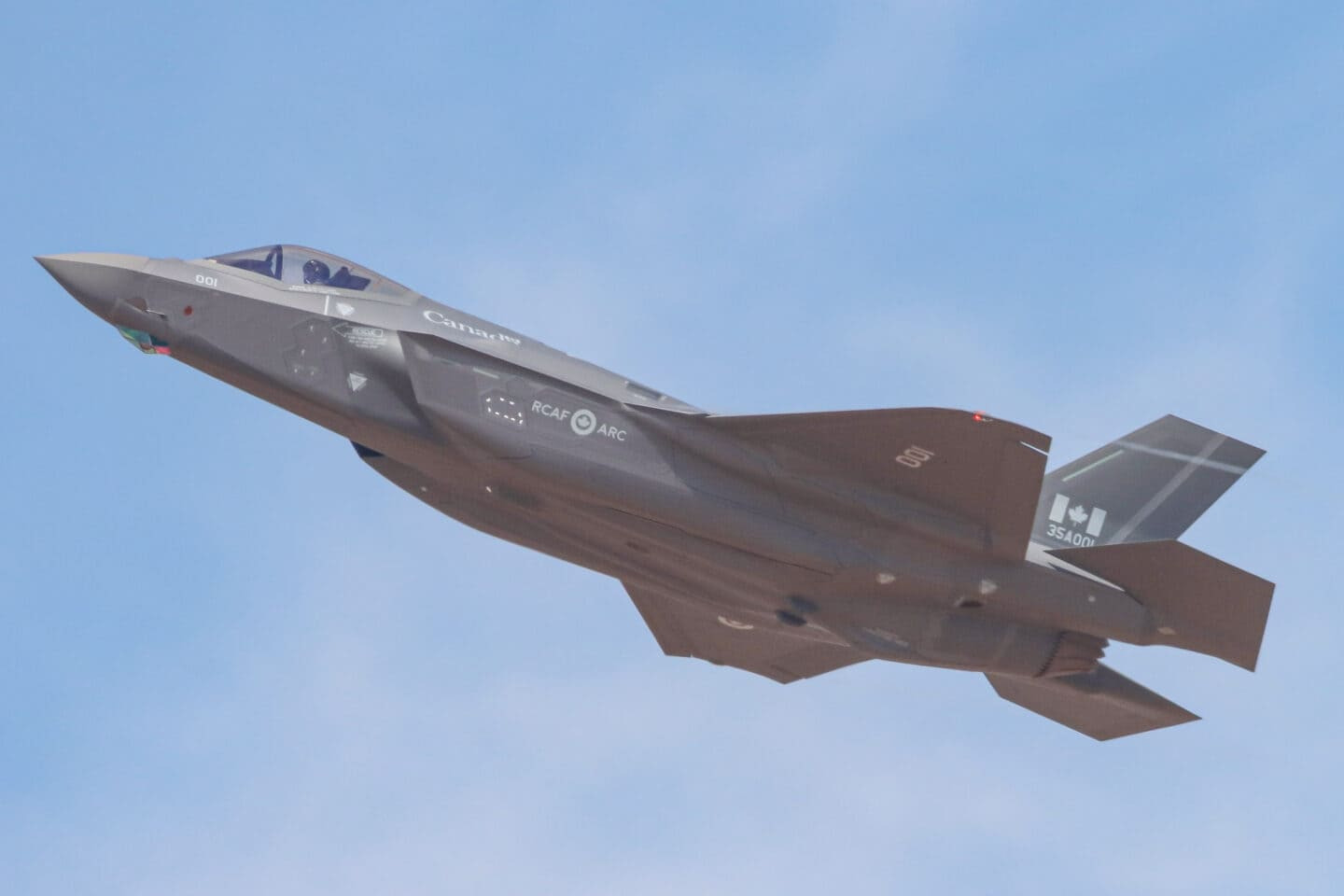
History:
Canada would begin its relationship with the F-35 in 1997, when it invested 10 million dollars into the concept demonstration phase of the Joint Strike Fighter program, under the Jean Chrétien government. This would be followed up on in 2002, when Canada invested $150M more so it could participate in the System Development and Demonstration phase, which was slated to last 10 years. 2006, Canada, alongside its allies, would sign a memorandum of understanding for Production, Sustainment and Follow-on Development during the period of 2007 to 2051, with the anticipated cost of that for Canada being over half a billion dollars.
In the years 2006 to 2009, the Canadian Air Force would conclude that the F-35; however, at that time there was only one JSF test model, meaning there was no way to prove that it was actually cheap. Despite signing a memorandum of understanding under a conservative government, Canada would emphasize that the commitment didn’t automatically mean Canada would buy the plane. According to the Auditor General, Canada still had to accept F-35 procurement rules; they had also claimed that ministers weren’t fully informed of this aspect. the 12th of May in 2008, the Canada First Defence Strategy called for replacing the CF-188s starting in 2017. Around that time, DND had asked the current Conservative government to buy the F-35, but that was denied.
In the early 2010s, the Pentagon would notify Canada of the fact that the US is reassessing cost projections due to delays in development.
Defence Minister Peter MacKay would tell the Commons that Canada would buy the F-35, but just over an hour later he would say he misspoke and that there would be an open competition, yet six weeks later, once again ignoring what was previously said, MacKay would announce that Canada was purchasing 65 F-35s at a cost of $9 billion with deliveries to begin in 2016. On the 10th of July in 1010, the government would announce these planes, calling it the only 5th gen to meet Canada’s needs well, allowing for interoperability with NATO allies. Opposition parties would query the decision to sole-source. The Auditor General would point out that, while all the required documentation was prepared, key steps were taken out of sequence, without the required approvals. Public Works officials would receive a more formal statement of operational requirement for the DND, as that was required to justify procuring the F-35 without running a competition.
It was reported in September of 2010 that the Canadian Forces had planned to hold a competition in 2010, with the winner getting the contract awarded to them in 2012, allowing for the fighter to be operational at some point between 2018 and 2023. On the 6th of October in 2010, retired Assistant Deputy Minister of National Defence (Matériel) Alan Williams would testify before the House of Commons Defence Committee in regard to the F-35, which the media was already painting in a bad light, calling it a “Flying Credit Card – with no prefixed spending limit”. Even though Williams was the ADM who originally signed the industrial participation, he would testify that a lack of a competition would squander billions of dollars in both taxes and lost business opportunities. Throughout October, there would be a lot of back-and-forth of media and government officials.
November would see representatives from both Boeing and Dassault complain; they weren’t even considered, as DND requested nothing from them. December would see Eurofighter and Saab put forward their own fighters as cheaper alternatives, but government branches wouldn’t budge on the F-35. By the end of 2010, each of the political parties in Canada had picked a side: the Conservatives sticking with straight-up buying the F-35, Liberals running a competition for a new fighter, New Democratic Party not buying it at all, and the Bloc Québécois only cared that whatever the outcome, Quebec companies got some of the work.
Early 2011 would see the US state that the F-35B was facing delays, but reassure that the Canadian ones would arrive on time. However, this would not calm the growing drama, where all sides had begun attacking each other over their stance. January of 2011 would deal with another issue: that the F-35 couldn’t work with what Canada had, so despite Canada buying the F-35A, it would be the refuelling probe-equipped F-35B/C and a drag chute. Because of non-confidence in the budget put out by the conservative government, an election would be called, and in turn, making the F-35 a major issue in the election.
Well, the Conservatives were able to form a majority government; their luck would turn sour after that. With multiple leaks revealing that the F-35 was much more expensive and much worse than what was revealed to the public and government, devolving into a scandal, that would lead the Conservatives to backtrack on their stance on the F-35, making it so it was no longer a guarantee under them. This would even allow military members to speak against the F-35 despite the fact most people related to the military continue to make claims and effort so show that the F-35 is the only plane they want.
With the changing tides on the F-35, in May of 2012, Lockheed Martin threatened that Canadian companies would get no future contracts. Despite this, they suggest Canada was going full steam ahead with the F-35 purchase even when the government itself was saying it wasn’t. 2012 would also see Emails released that showed that DND knew that F-35 deliveries wouldn’t be finished until long after it was time to replace the CF-188, which contradicts assertions that a stopgap wasn’t needed. It would also be revealed around that time by Julian Fantino, the associate defence minister, that the mandatory requirements for the replacement aircraft would let no one but the F-35 win.
It would be revealed in December of 2012 that the Harper government had been kept up to speed on all the problems that the F-35s had been having, and still ran on a platform that the F-35 buy would be all sunshine and rainbows. Because of all this negative info, press, like the Ottawa Citizen, would run articles about the federal government cancelling the F-35. Although the Prime Minister’s Office would respond to these claims, saying it wasn’t true and the order wasn’t cancelled. Around the same time, people like the interim Liberal Leader Bob Rae would call for the resignation of the Defence Minister, Mackay, viewing him as nothing more than a salesperson for Lockheed Martin. The government would also release the KPMG report on the 12th of December 2012, which revealed that part of the cost for the F-35 was much higher than what was said, with a $45.8 billion CAD cost over 42 years and a price of $92 million per aircraft compared to the $75 million said earlier.
In 2013, Canada would send out a questionnaire to the companies, Lockheed Martin, Boeing, Dassault, EADS and SAAB, to get more information on their fighters. Public info on this suggested that Canada could be considering these other fighters as a stopgap while waiting on the F-35. February would see Boeing move to start a campaign for the Super Hornets, while April would see Lockheed Martin start one for the F-35; this would be paired with the company announcing that it now costs $85 million USD per aircraft. May would see Saab decline to take part in this round of evaluations. In June, e-mails would end up surfacing that instructed people to make it seem the negative impacts from the Auditor General’s report weren’t as bad as they seemed.
In early 2014, Dassault would begin its own campaign for the Rafale for Canada. In April, both the options analysis of all the fighters would be completed, along with an analysis from The Globe and Mail finding out that even with a competition held, it still led to the F-35, as the Statement of Requirements (SoR) was done in a way to require what it had. A briefing on the 27th of October involving Lt.-Gen. Chris Bogdan, who was the head of the F-35 program in the Pentagon, would reveal that the government was moving to buy 4 F-45s to start with behind closed doors, which would lead to the other parties to criticize the Conservatives and how they haven’t learned anything about the earlier drama about the F-35. In December of that year, would see oil prices collapse, which would bring down the Canadian dollar, which would help rise the price of the F-35. DND would even state they wouldn’t be able to buy the full order under the current price, well under a different report around the time that Canada was unlikely to take part in first strike operations and there was little need for a stealth aircraft.
2015 would see the F-35 return again as an election issue, because of all the issues that showed up last year. The Liberals under Justin Trudeau would, in part, campaign by running a competition to find a non-F-35 alternative, while using the saved money on the navy. The NDP would respond by saying they would run a fair competition that included the F-35. Well, the Green Party would say it would cancel the order and use all the money on search and rescue aircraft and other non-combat things. And the Conservatives didn’t even have the F-35 as part of their platform. The Liberals would win a majority government on the 19th of October, 2015, yet when questioned if they’d follow through on having a competition without the F-35, they’d brush it off, stating it would be an open process.
Canada would miss a required payment for the F-35 consortium in 2016, but the government didn’t mean they were pulling out of the project, and would later that year make a proper payment. June would see a number of media reports that the Liberals had moved to buy the Super Hornets as an interim fighter. The news would make Lockheed Martin, once again, threaten contract loss if the government buys anything but the F-35, this time with active contracts too. People who had criticized the Harper government for that very same action would be shocked, as the Liberals themselves had spoken out against the Harper government when they did the same thing. An official announcement of this purchase would happen on the 22nd of November 2016, as a replacement for the CF-188 was needed now; unfortunately, this order would be cancelled when Boeing had the US government hit Bombardier over its CSeries airliners, leading them to sell them to Airbus. Canada would buy 18 of Australia’s legacy Hornets instead to keep the fleet running while the competition is held. Reports would also come out that companies would be assessed on their impact on Canada’s economic interests, likely as a way to punish Boeing for its actions against Canada.
July of 2019 would see the same companies that were invited earlier being reinvited for a competition to purchase 88 new fighters. Dassault and Airbus would pull out their aircraft, starting the NORAD and Five Eyes requirements where two much. January of 2021 would see Saab offering for the Gripen E to be built in Canada if it was picked. Well, in November, Boeing was informed that the Super Hornet did not meet Canada’s requirements. On the 28th of March 2022, Canada announced that the F-35 had won the competition, but negotiation talks still had to happen, and if they fell through, talks with Saab would begin. The Canadian government would announce a deal had been signed on the 9th of January 2023, to buy 88 F-35s at Block 4 specs that were meant to have the first one delivered in 2026 and finished between 2032 and 2034.
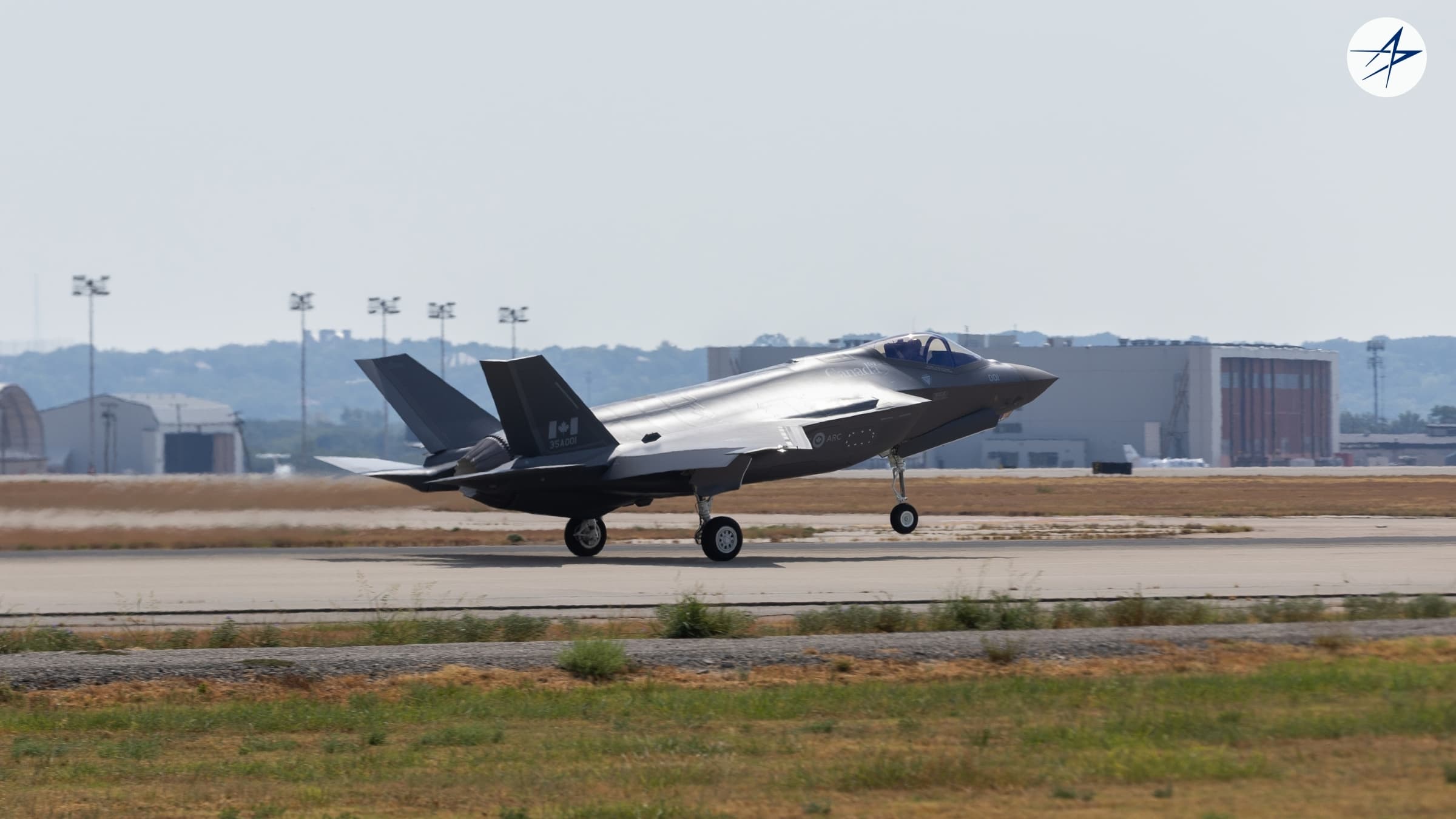
Canada would begin looking at alternatives as it enters a review of the F-35 purchase in March of 2025, due to annexation threats and tariffs from the United States. It would announce that, because the first 16 airframes have been fully paid for, it would still receive them, but the rest of the fleet could be made up of any mix of aircraft. This was to be completed by the 21st of September in 2025, but as of writing this, it has yet to be completed. News articles would reveal that Canada had put down a payment for 14 more F-35s but never announced it officially. An F-35 in Royal Canadian Air Force markings, making it the first CF-35A, would make its first flight on the 23rd of September 2026 out of Naval Air Station Joint Reserve Base Fort Worth. Well, the RCAF would formally receive its first 2 CF-35s on the 22nd of October 2026 at Luke Air Force Base, in Arizona, where they’ll stay until both initial training and infrastructure for them is completed on the Canadian side.
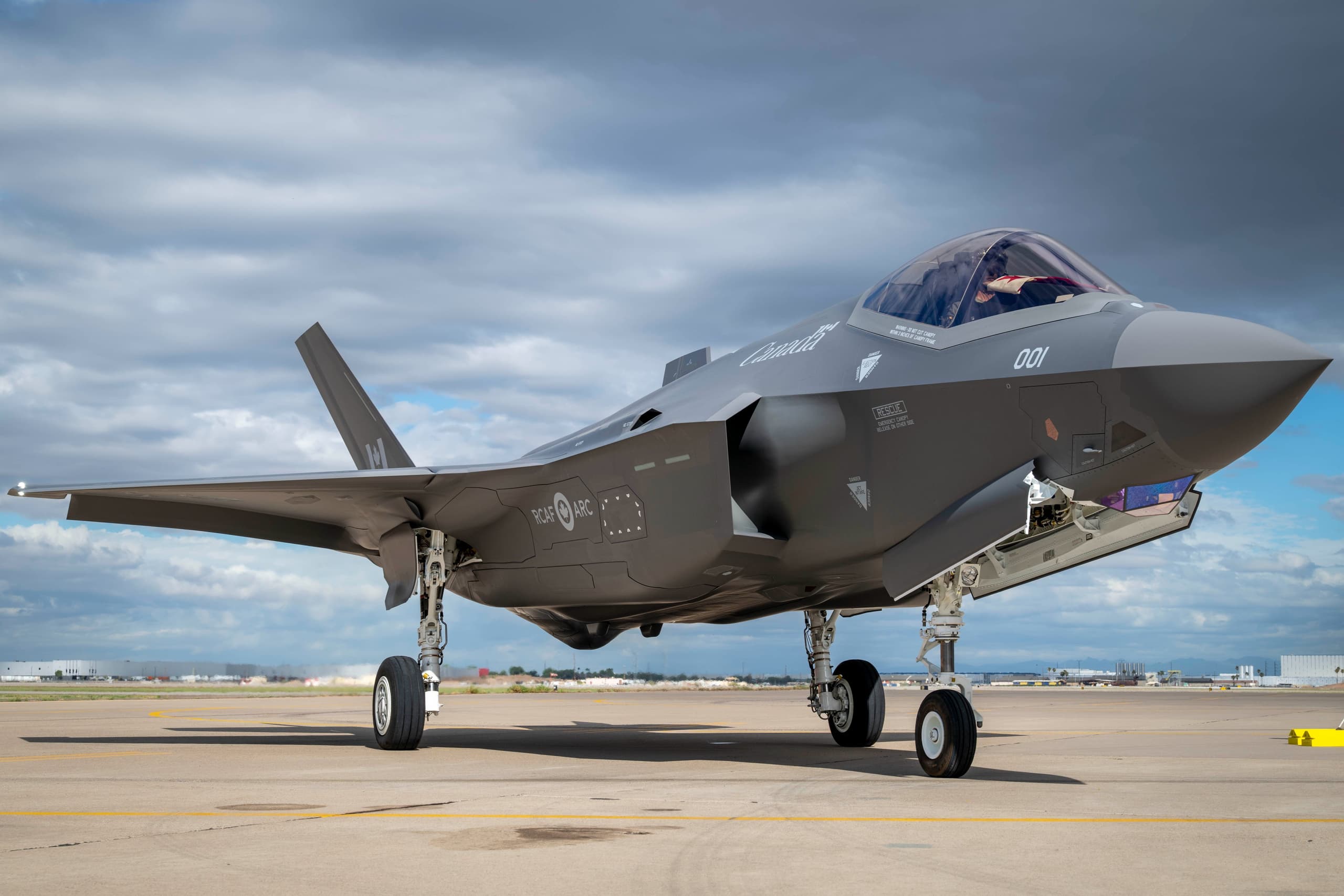
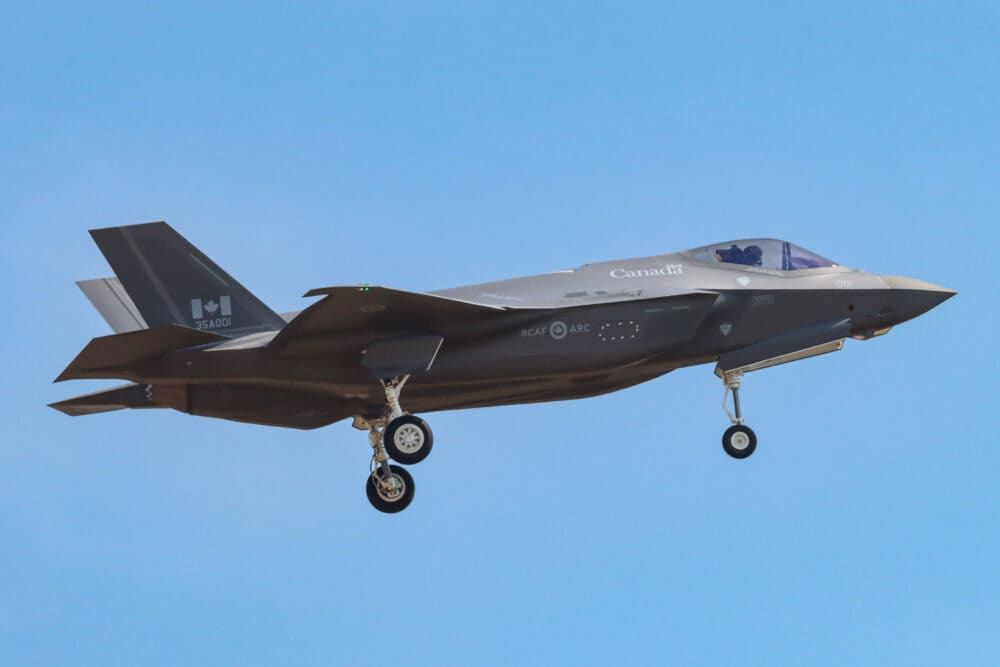
Specs:
Crew: 1
Length: 51.4 ft (15.7 m)
Wingspan: 35 ft (11 m)
Height: 14.4 ft (4.4 m)
Wing area: 460 sq ft (43 m2)
Aspect ratio: 2.66
Empty weight: 29,300 lb (13,290 kg)
Gross weight: 49,540 lb (22,471 kg)
Max takeoff weight: 65,918 lb (29,900 kg)
Fuel capacity: 18,250 lb (8,278 kg) internal
Powerplant: 1 × Pratt & Whitney F135-PW-100 afterburning turbofan, 28,000 lbf (120 kN) thrust dry, 43,000 lbf (190 kN) with afterburner
Performance:
Maximum speed: Mach 1.6 at high altitude (1,228 mph / 1,976 km/h)
Mach 1.06, 700 knots (806 mph; 1,296 km/h) at sea level
Range: 1,500 nmi (1,700 mi, 2,800 km)
Combat range: 669 nmi (770 mi, 1,239 km) interdiction mission (air-to-surface) on internal fuel
760 nmi (870 mi; 1,410 km), air-to-air configuration on internal fuel
Service ceiling: 50,000 ft (15,000 m)
g limits: +9.0
Wing loading: 107.7 lb/sq ft (526 kg/m2) at gross weight
Thrust/weight: 0.87 at gross weight (1.07 at loaded weight with 50% internal fuel)
Armament:
Guns: 1 × 25 mm GAU-22/A 4-barrel rotary cannon, 180 rounds
Hardpoints: 4 × internal stations, 6 × external stations on wings with a capacity of 5,700 pounds (2,600 kg) internal, 15,000 pounds (6,800 kg) external, 18,000 pounds (8,200 kg) total weapons payload, with provisions to carry combinations of:
Missiles:
Air-to-air missiles:
AIM-9X Sidewinder
AIM-120 AMRAAM
Air-to-surface missiles:
AGM-88G AARGM-ER (Block 4)
AGM-158 JASSM
SPEAR 3 (Block 4, in development, integration contracted)
AGM-88J Stand-in Attack Weapon (SiAW)
Bombs:
Joint Direct Attack Munition
Paveway
Precision-guided glide bomb:
AGM-154 JSOW
GBU-39 Small Diameter Bomb
GBU-53/B StormBreaker
B61 mod 12 nuclear bomb
Avionics:
AN/APG-81 or AN/APG-85 (Lot 17 onwards) AESA radar
AN/AAQ-40 Electro-Optical Targeting System
AN/AAQ-37 Electro-Optical Distributed Aperture System
AN/ASQ-239 Barracuda electronic warfare/electronic countermeasures system
AN/ASQ-242 CNI suite, which includes
Harris Corporation Multifunction Advanced Data Link (MADL) communication system
Link 16 data link
SINCGARS
An IFF interrogator and transponder
HAVE QUICK
AM, VHF, UHF AM, and UHF FM Radio
GUARD survival radio
A radar altimeter
An instrument landing system
A TACAN system
Instrument carrier landing system
A JPALS
TADIL-J JVMF/VMF
Other features ordered with the CF-35 order in 2022 were a drag chute pod for landings at short/icy Arctic runways, as well as the ‘sidekick’ system, which allows the CF-35 to carry up to 6 x AIM-120D missiles internally (instead of the typical internal capacity of 4 x AIM-120 missiles on other variants)
Sources
Royal Canadian Air Force on X: "The RCAF received its first two CF35As yesterday at Luke Air Force Base in Arizona. The future of air and space power is built on more than equipment alone." / X
Lockheed Martin F-35 Lightning II - Wikipedia
Lockheed Martin F-35 Lightning II Canadian procurement - Wikipedia
https://www.youtube.com/watch?v=MSfw5KvuchI
Canada’s first CF-35A fighter jet completes maiden flight - Skies Mag
Lockheed Martin Canada on X: "The first CF-35A took to the skies for the first time today." / X
Tori Mae Fontana on X: "Oh, Canada! 🇨🇦 The first test flight of the Canadian F-35 took place this afternoon from Lockheed Martin in Fort Worth. This is the aircraft on landing after completing a 90-minute test flight. Check out @TheAviationist for the article featuring photos from both myself a… / X
The CF-35 is now in RCAF Hands | Billie Flynn - My Blog
Canada receives first F-35 jets from U.S., as full order remains under review | CBC News
F-35 Lightning II | Lockheed Martin
Canada
https://www.canada.ca/en/department-national-defence/services/procurement/fighter-jets/future-fighter-capability-project.html
RCAF Receives First F-35 Fighters at Luke Air Force Base - Canadian Defence Review
Canada Receives Its First Two CF-35A Fighters at Luke Air Force Base - The Aviationist
Canadian Warplanes 6: Lockheed Martin CF-35 Lightning II, RCAF - SilverHawkAuthor Website Military History Materials
https://ottawa.citynews.ca/2026/10/25/canada-receives-its-first-f-35-jets-from-u-s-as-full-order-remains-under-review/