- Yes
- No
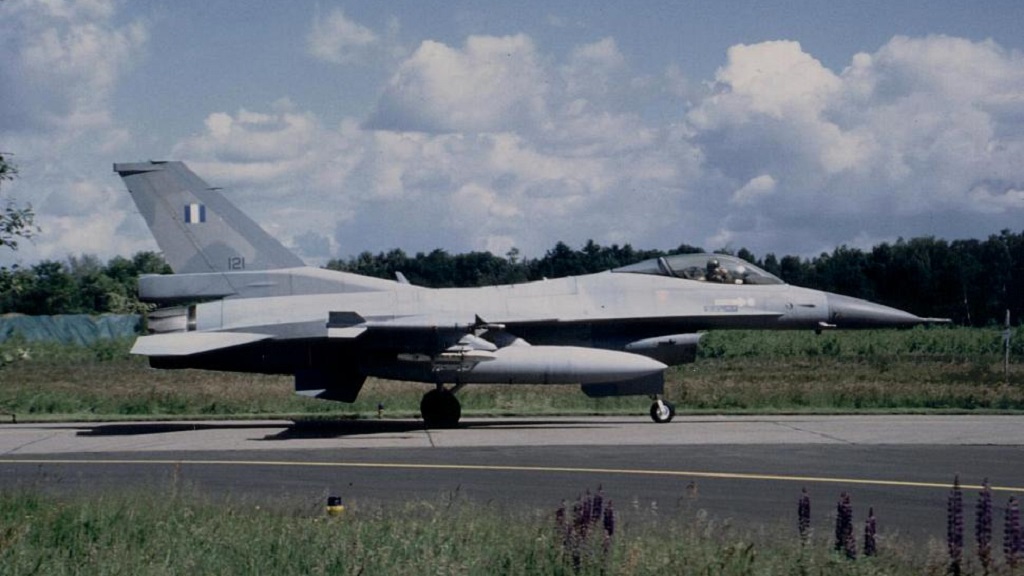
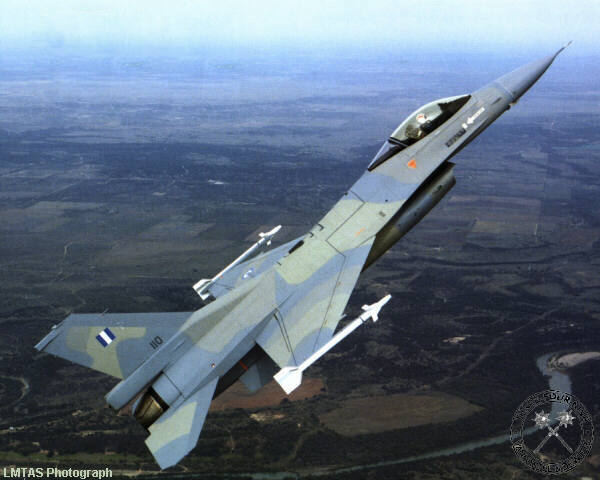
The F-16C/D Block 30 was the first of the many F-16 Greece got throw-out multiple years. It has proven its worth and even today after almost 40 years still serves in HAF (Hellenic Air Force).
F-16 Block 30 History
In the early 1980s, the U.S. Air Force decided it no longer wanted to depend solely on the Pratt & Whitney F100 for the F-16. Through the Alternative Fighter Engine (AFE) program, it opened the competition to General Electric. In February 1984, GE secured the majority of the engine contracts for the FY1985 production run. This decision produced the Block 30/32 series—the first F-16s built with a common engine bay that could accept either the new GE F110-GE-100 or the improved Pratt & Whitney F100-PW-220.
The resulting designation system has endured ever since: any block number ending in “0” uses a GE engine, while one ending in “2” uses a Pratt & Whitney engine. Block 30 aircraft received the more powerful F110 (roughly 5,000 lb more thrust than the contemporary F100). Early Block 30s retained the original “small-mouth” inlet. Starting with later 1986/87 production (from aircraft 86-0262 onward, often called Block 30D), the larger “big-mouth” Modular Common Inlet Duct was fitted so the GE engine could deliver its full performance, especially at lower speeds. Block 32 aircraft kept the smaller inlet and the Pratt engine.
The first Block 30 F-16C (85-1398) flew on 12 June 1986; the first two-seat Block 30 and the first Block 32s followed shortly afterward. Series production began in January 1986, with the first deliveries to the Air Force in July 1987. Manufacturing ended in 1989 after approximately 733 aircraft had been built.
Beyond the engine changes, Block 30/32 aircraft introduced several operational upgrades. From 1987 they gained the ability to fire the AGM-88 HARM and AGM-45 Shrike anti-radiation missiles, full multi-target AIM-120 AMRAAM capability, expanded computer memory, Seek Talk secure voice communications, a voice message unit, a crash-survivable flight-data recorder, and (from the D sub-block) twice as many chaff/flare dispensers plus the distinctive “beer-can” radar-warning antennas on the leading-edge flaps.
These jets initially equipped front-line USAF squadrons, gradually replacing the earlier Block 25s. As newer Block 40/42 and 50/52 aircraft arrived in the late 1980s and 1990s, most Block 30/32s moved to the Air National Guard, Air Force Reserve, aggressor, and test units. A small number of modified Block 30s also served the U.S. Navy as F-16N adversary aircraft. Export customers included Greece, Israel, and Turkey (primarily Block 30) and Egypt and South Korea (primarily Block 32).
Many of these airframes remain in service today after structural life-extension programs and various avionics and targeting-pod upgrades, continuing a production history that began nearly forty years ago.
F-16 Block 30 History in Greece
In the early 1980s Greece needed modern fighters to replace its ageing F-5 Freedom Fighters (and, to a lesser extent, its F-104s). After evaluating several types, including the F/A-18, the government under Andreas Papandreou announced in 1984–85 what became known in Greece as the “Αγορά του Αιώνα” (Buy of the Century).
Instead of selecting a single type, Athens ordered two: 40 F-16C/D Block 30s from the United States and 40 Mirage 2000s from France. The dual purchase was driven by a combination of operational needs, political considerations (balancing U.S. and European suppliers and reducing the risk of future embargoes), and the desire to modernize the Hellenic Air Force (HAF) quickly against the perceived Turkish threat. The overall cost of the fighter package was initially estimated at more than 200 billion drachmas and later rose significantly. The program was also accompanied by controversies over offsets, pricing, and alleged irregularities.
More info about the controversies
In the early 1980s the Hellenic Air Force evaluated new fighters and its senior leadership unanimously recommended the twin-engine F-18L, which offered better overall performance, longer range and greater survivability than the single-engine alternatives. Economic studies suggested that for roughly the same money Greece could have bought 100–120 of them instead of a mixed fleet. After PASOK came to power in 1981, Andreas Papandreou rejected that advice and in 1984–85 announced the “Buy of the Century”: 40 F-16 Block 30s from the United States and 40 Mirage 2000s from France. The official reasons were to avoid total dependence on America and to balance relations with France, but critics argued the decision was driven more by politics than by military needs. Splitting the order into two different types raised long-term costs through duplicated logistics, training and spare parts, while Greece obtained far weaker industrial offsets than Turkey later did with its large single-type F-16 program. Allegations of overpricing and commissions also surrounded both deals, turning the purchase into one of the most debated and controversial defense programs of the decade.
So basically they chose 80 F-16/Mirage 2000 (40-40) over 120 F/A-18s because of corruption, another Greek classic.
The American portion of the deal was formalized in January 1987 under the Foreign Military Sales program Peace Xenia I. Greece received 34 single-seat F-16C and 6 two-seat F-16D Block 30 aircraft, all powered by the General Electric F110-GE-100 engine. The first aircraft were handed over in the United States in late 1988; the first arrived in Greece on 20 January 1989 at 111 Combat Wing (Nea Anchialos). Deliveries continued through 1989 and into early 1990.
The new jets initially equipped two squadrons:
- 330 Mira “Keravnos” (Thunder) – formed in January 1989
- 346 Mira “Iason” (Jason) – formed later and also based at Nea Anchialos
In 1997, 346 Mira moved to Larissa (110 Combat Wing). It was disbanded in 2011 and its remaining Block 30s returned to 330 Mira, which has since been the sole HAF operator of the type.
In the mid-1990s the Block 30 fleet underwent the Falcon Up structural life-extension program at Hellenic Aerospace Industry (HAI). This roughly doubled the airframe life from 4,000 to 8,000 flight hours. The aircraft later received AIM-120 AMRAAM capability and other incremental improvements, but they were never upgraded to the full Viper (Block 70/72) standard applied to later Greek F-16s.
Today the remaining Block 30s continue to fly with 330 Mira. While the bulk of the HAF F-16 fleet (Blocks 50, 52+ and 52M) is being modernized to F-16V “Viper” configuration, the older Block 30s are expected to serve in a transitional or secondary role until they are eventually retired or sold. They remain a significant part of Greece’s early F-16 story and of the large-scale “Buy of the Century” modernization of the 1980s.
Technical Specifications
More Info
- Crew: 1
- Length: 15.03 m (49 ft 4 in)
- Wingspan: 9.45 m (31 ft 0 in)
- Height: 5.09 m (16 ft 8.5 in)
- Empty Weight: 8,570 kg (18,900 lb)
- Max Takeoff Weight: 19,200 kg (42,300 lb)
- Powerplant: 1 × General Electric F110-GE-100 turbofan
- Dry thrust: 76.3 kN (17,155 lbf)
- Thrust with afterburner: 128.9 kN (28,984 lbf)
- Max Speed: Mach 2.00 (approx. 2,100 km/h / 1,333 mph at altitude)
- Service Ceiling: 15,240 m (50,000 ft)
- Radar: AN/APG-68 (V3 or similar early variant)
- Defensive Systems: AN/ALR-69 RWR, ALE-47 chaff/flare dispensers
Greek F-16 Blocks Visual Differences
Spoiler
All Hellenic F-16s except the Block 30s feature the AN/APX-113 IFF interrogator antennas in front of the canopy. The Block 30s are the only Greek F-16s which have a intercept light on the starboard side of the fuselage, just below and in front of the canopy.
Aegean Ghost Camouflage
More Info
The color scheme of the HAF F-16s is known as the “Ghost” or “Aegean Ghost” scheme and is one of the most interesting in modern military aviation. This distinctive camouflage was first tested on several aircraft such as the Mirage F-1CG but was never used. It was adopted on some F-5As for a short period of time just before their retirement, but more extensively used on all the F-4E Phantom IIs after their AUP upgrade. All the F-16s in Hellenic service wear this scheme but in this case this a special coating has been applied.
Armament
More Info
Air to Air missiles:
AIM-9M
Aim-9J
Aim-9PGuided Weaponry:
AGM-65BDumb bombs:
Mk-81 General Purpose (GP) Bomb
Mk-82 General Purpose (GP) Bomb
Mk-82 500lb / Mk-15 Snakeye
Mk-83 General Purpose (GP) Bomb
Mk-84 General Purpose (GP) Bomb
Mk 36 Destructor bomb
MK-20 ROCKEYE
BLU-109/B (Bomb Live Unit)
Μ-129 Leaflet 250 lbs
M-117 General Use 750 lbs
Sources
More Info
- F-16.net](https://www.f-16.net/f-2. Hellenic Air Force 115 Combat Wing - Souda’s Vipers - Chania, Crete, Greece - MILAVIA Military Aviation Specials
- F-16 - Παραγγελίες αεροσκαφών
- https://www.haf.gr/arsenal/
- https://www.haf.gr/arsenal/f-16-cd-block-30-50/
- ΖΕΥΣ - Photos | Flickr
- F-16 Peace Xenia - Hellenic Air Force
- https://cmano-db.com/aircraft/780/16_users_article5.html
- F-16 Fighting Falcon - Μαχητικό αεροσκάφος
- Κινητήρες και συστήματα αυτοπροστασίας F-16