- Yes
- No
- Absolute Naval Dominance (Yes)
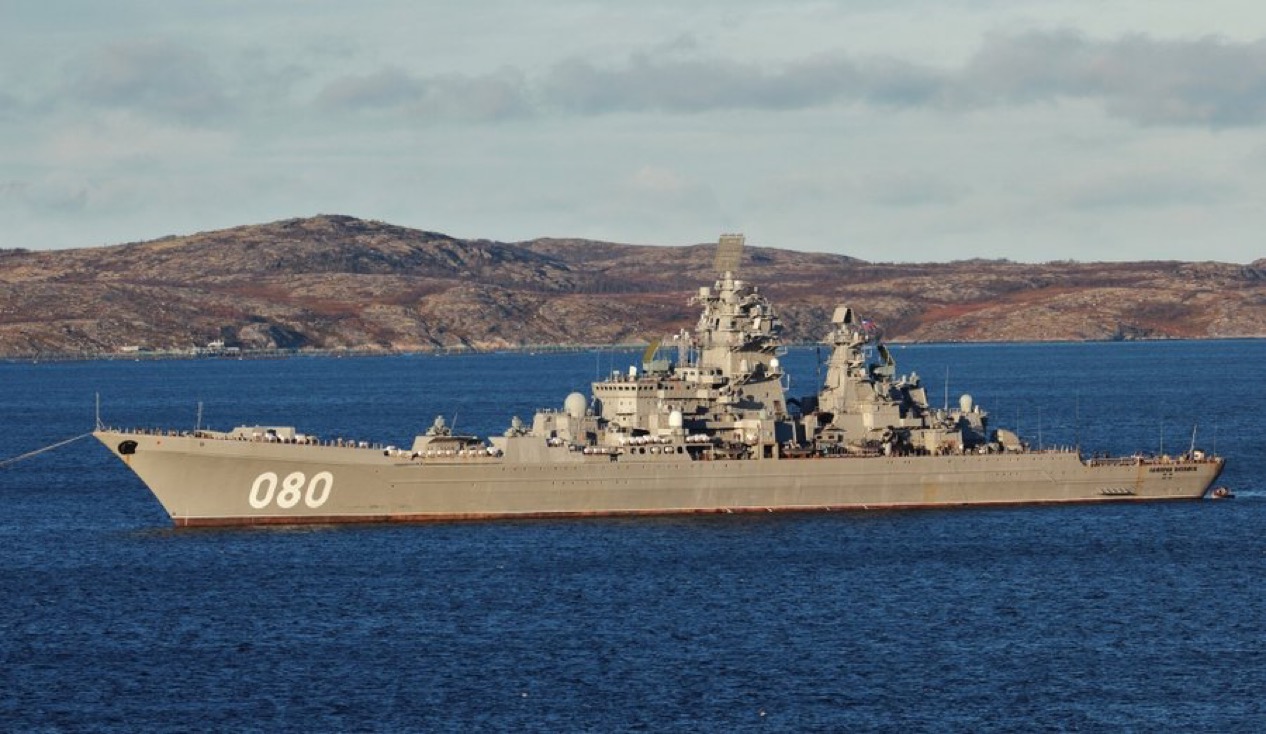
 Project 1144 Admiral Nakhimov - 80 Zircons, Zero Remorse
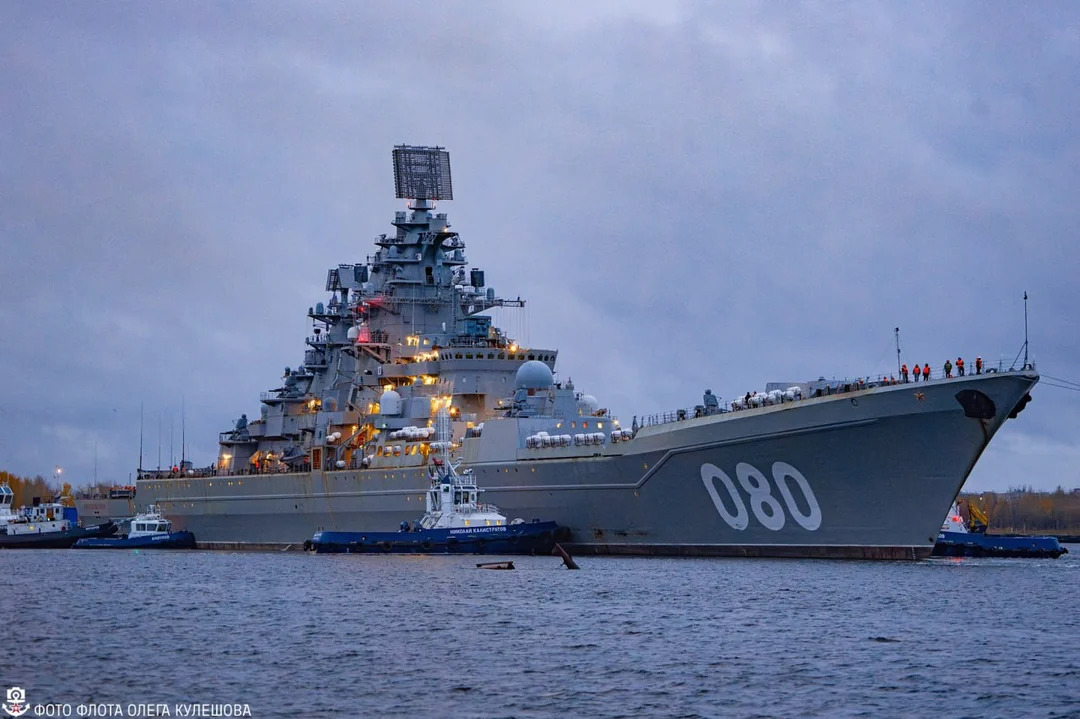
History:
The Kirov class (officially Project 1144 Orlan) heavy nuclear-powered missile battlecruisers were conceived in the late 1960s to solve a critical tactical dilemma for the Soviet Navy: how to locate, track, and destroy U.S. Navy Carrier Strike Groups (CSGs) across open ocean theatres. Standard surface combatants lacked both the endurance and the magazine depth necessary to survive counter-strikes while launching coordinated, high-volume anti-ship missile salvos.
Laid down on November 17, 1983, at the Baltic Shipyard in Leningrad, Kalinin was constructed under the modified Project 11442 specification. This third unit of the class introduced modern combat upgrades over earlier sister ships Kirov and Frunze, substituting legacy single 100mm guns with the twin-barrel 130mm AK-130 and integrating the world’s first hybrid gun/missile Close-In Weapon System (CIWS), the 3M87 Kortik.
Commissioned into the Soviet Northern Fleet on December 30, 1988, Kalinin conducted blue-water power projection operations in the North Atlantic and Mediterranean. Following the dissolution of the USSR, she was renamed Admiral Nakhimov in April 1992. Due to economic collapse and severe funding constraints, her operational career was cut short; after her last active deployment in 1997, she was towed to the Sevmash Shipyard in Severodvinsk in 1999 and placed into long-term reserve.
The Project 11442M Overhaul (2014-2026)
While initial plans called for a standard repair, the Russian Ministry of Defence pivoted to a complete overhaul under Project 11442M, transforming Admiral Nakhimov into the most heavily armed surface combatant in naval history.
- 2014-2020 (Structural Stripping): Sevmash workers gutted the ship, removing over 5,000 tons of legacy Cold War electronics, mechanical linkages, and the massive forward-angled P-700 Granit missile silos.
- 2020-2024 (Reactor Overhaul): Both KN-3 pressurized water nuclear reactors were completely overhauled and refueled, officially re-started in early 2025.
- 2025-2026 (Sea Trials & Recommissioning): The ship departed Sevmash for White Sea factory trials in August 2025, returning to her home port of Severomorsk in June 2026 to complete final acceptance tests prior to assuming flagship duties for the Northern Fleet.
Total modernization expenditures exceeded $5 billion (200+ billion rubles).
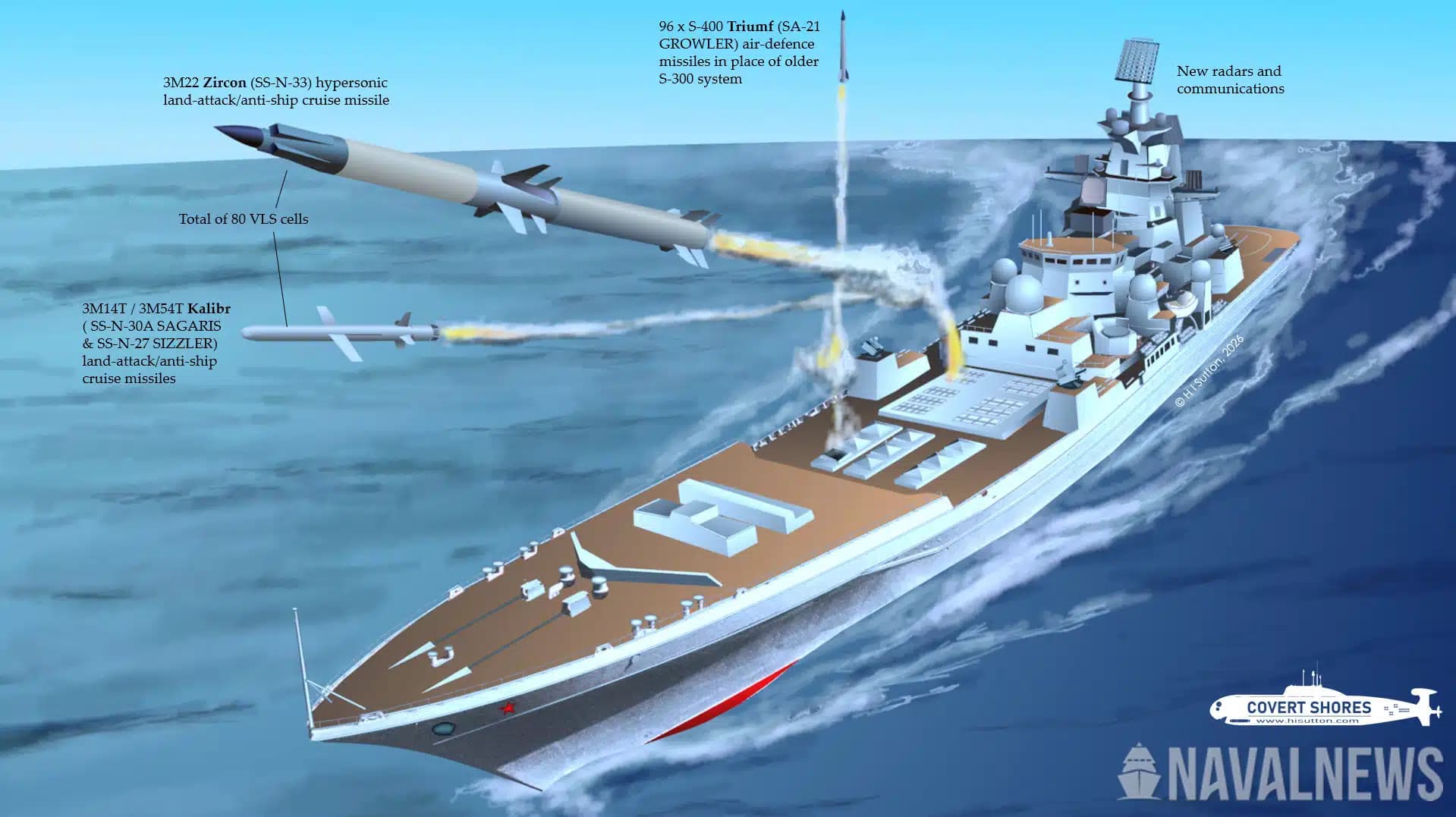
Specifications:
General Characteristics & Propulsion
- Displacement: 24,100 tons (standard) / 28,000 tons (full load)
- Length: 252 meters (827 ft)
- Beam: 28.5 meters (94 ft)
- Draft: 9.1 meters (30 ft)
- Propulsion: CONAS (Combined Nuclear and Steam) system featuring 2x KN-3 nuclear reactors paired with 2x oil-fired superheated steam boilers generating 140,000 shaft horsepower (shp)
- Top Speed: 31-32 knots (57-59 km/h)
- Range: Unlimited on nuclear propulsion ~1,000 nautical miles at 30 knots on emergency boilers alone.
Armor & Internal Protection
- Main Machinery Belt: 100mm face-hardened armor surrounding reactor spaces and steam turbines.
- Deck Armor: 76mm protective plating over vital magazine compartments.
- Steering & Control Protection: 50mm internal armor shields.
- Conning Tower / Combat Information Center: 75-100mm composite armor.
Air & Surface Search Radars
- 5P-20K “Poliment” 4-Faced Active Electronically Scanned Array: Integrated directly into the main superstructure. Provides 360-degree, multi-band 3D volume search, automated threat prioritization, and simultaneous multi-target tracking/fire control guidance for the ship’s long- and medium-range SAM interceptors.
- Maximum Search Range: 200-300 km depending on the target’s radar cross-section.
- MR-650 “Podberezovik” 3D Air Search Radar: An L-band long-range volume surveillance radar mounted on the main mast. Operates out to 500+ km to detect high-altitude bombers, incoming ballistic missiles, and low-RCS aircraft.
- Maximum Instrumented Range: Up to 500 km.
- Fighter-Sized Target Detection: 400 km.
- Sea-Skimming Missile Detection: 45-70 km (limited by the curvature of the Earth).
- Fregat-M2M / MR-750 “Top Plate” 3D Radar: Serves as a back-up and secondary air/surface surveillance radar operating in the E-band, specialized in detecting low-flying sea-skimming cruise missiles.
- Maximum Range: 230 to 300 km.
Targeting & Fire Control Radar Systems
- 34K1 “Monolit-ME” / “Mineral-ME” Targeting Suite: Over-the-horizon active and passive radar complex mounted atop the bridge tower. Capable of passive detection of hostile radar emissions up to 450+ km to provide targeting coordinates for Zircon , Oniks , and Kalibr anti-ship missiles without revealing the ship’s own position.
- Active Radar Mode: Up to 250 km (utilizing atmospheric ducting/super-refraction to search over the horizon).
- 5P-10 “Puma” Fire Control System: An integrated radar and optoelectronic fire-control system dedicated exclusively to tracking surface/air targets and guiding the single-barrel 130mm AK-192M main gun.
- 1RS2-1E / 1RS3 Dual-Band Radar (Pantsir-M): Phased-array tracking and fire-control radars mounted on each of the 6 Pantsir-M CIWS modules, providing millimeter-wave radar tracking for short-range interceptor missiles and30mm rotary cannons.
Sonar & Undersea Sensors
| Sensor System | Location | Operational Function |
|---|---|---|
| Zarya-3 / MGK-355M Suite | Bow Bulb | Massive low-frequency active/passive hull-mounted sonar for long-range submarine detection. |
| Vinyetka-EM | Stern Hull Hatch | Low-frequency Variable Depth Sonar (VDS) towed array designed to penetrate oceanic thermoclines and track quiet diesel-electric and nuclear submarines. |
| MG-757.3 “Anapa-M” | Hull-Mounted | High-frequency anti-saboteur sonar dedicated to detecting underwater divers, swimmer delivery vehicles (SDVs), and mini-torpedoes near the hull. |
Weaponry and Countermeasures
Cannon
- AK-192M 130mm
- Configuration: Single-barrel 130mm automatic turret.
- Stealth Design: Unlike the bulky, angular AK-130 turret, the A-192M features a rounded, low-radar-cross-section (RCS) stealth housing, which helps keep the ship’s overall radar signature down.
- Rate of Fire: Approximately 45 rounds per minute. While this is lower than the ~90 RPM the twin-barrel AK-130 could achieve, the A-192M is significantly lighter and more advanced in its digital fire-control integration.
- Engagement Capabilities:
- Surface Targets: Effective range of up to 23 km.
- Airborne Targets: Effective range of up to 18 km.
- Advanced Fire Control: The system is fully automated and uses modern ballistic computers, laser rangefinders, and target-tracking radar to adjust fire in real-time, allowing it to engage precision targets or provide continuous support against air threats.
Anti-shipping/Land Attack
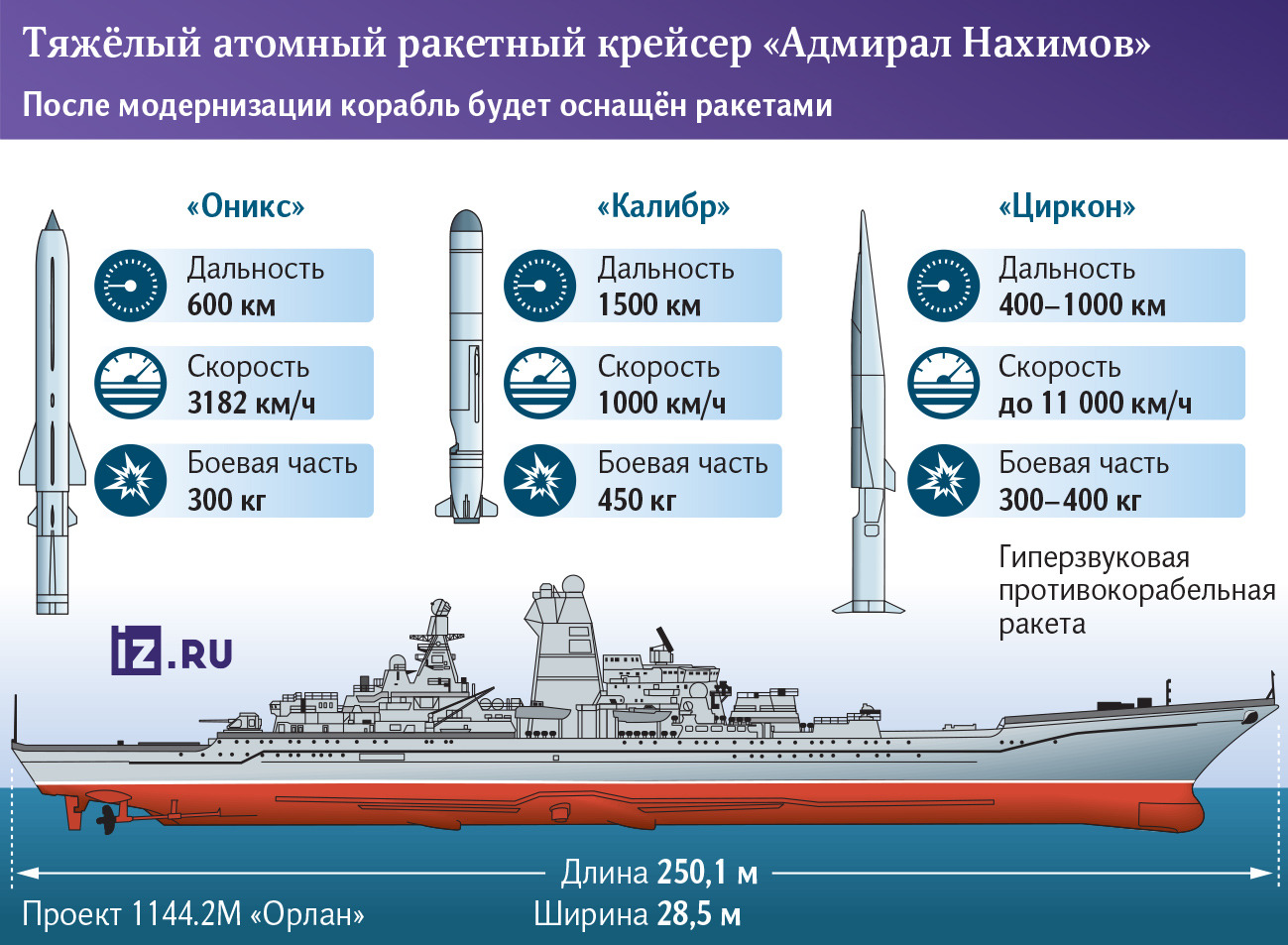
- 80x UKSK (3S14) Universal VLS Cells: Replaces the 20 legacy Granit tubes with 10 eight-cell modular launchers capable of housing:
-
- 3M22 Zircon: Hypersonic anti-ship/land-attack cruise missile (Mach 8+, 500-1,000 km range).
-
- P-800 Oniks: Supersonic low-altitude sea-skimmer (Mach 2.5).
-
- 3M54/3M14 Kalibr: Anti-ship and long-range land-attack cruise missiles.
Air defence
- 96x S-400 VLS SAM Cells: Long-range area air defense capable of engaging high-altitude aircraft and incoming anti-ship missiles out to 400+ km.
- 6x Pantsir-M Modules: Combined close-in system equipped with twin 30mm rotary cannons (up to 10,000 rpm combined) and 8x 57E6 short-range radio-command guided missiles per mount.
Electronic Warfare & Radar Jamming
- TK-25 / 5P-28 EW Suite: A modern multi-band electronic warfare (EW) system providing 360-degree passive Electronic Support Measures (ESM) and active Electronic Countermeasures (ECM). It automatically detects, classifies, and prioritizes radar emissions from enemy aircraft, surface search radars, and active radar-guided anti-ship missiles, deploying high-power directional jamming to blind or break target locks.
- Cantata-M / Prosvet-M RF Jammers: Specialized radio-frequency suppression arrays designed to flood enemy targeting channels and missile seeker heads with noise and deceptive false-target signals.
Passive Decoy & Chaff/Flare Dispensers
- PK-10 “Smelyi” Decoy System: Uses multiple 120mm KT-216 rapid-fire launcher batteries to deploy fast-acting radar chaff (radio-frequency lures), infrared flares (thermal lures), and optoelectronic decoys. These create large, high-RCS (Radar Cross-Section) false targets in close proximity to divert incoming self-guided missiles.
- PK-2M Decoy Launchers: Dual-barrel 140mm ZIF-121 rocket launchers firing long-range decoy rockets. These launch heavy chaff clouds (TSP) and thermal lures (TST) farther from the vessel to deceive long-range surveillance radars and infrared search sensors.
Anti-Torpedo Defense
- Paket-NK System: A dedicated 330mm anti-torpedo defense system designed to destroy incoming homing torpedoes. It fires M-15 anti-torpedoes (ATT) that physically intercept and detonate near incoming hostile torpedoes in the water, as well as MTT small anti-submarine torpedoes against hostile submarines.
- Udav-1M / RKTs-12000 (RBU-12000): A heavy 10-tube, 254mm anti-torpedo rocket system. It launches a combination of acoustic decoy rockets to divert incoming homing torpedoes and high-explosive depth-charge rockets to form a destructive underwater barrage across the incoming torpedo’s trajectory.
- Acoustic Countermeasures: Towed and expendable hydroacoustic decoys (e.g., MG-341 series) that emit high-intensity acoustic noise and deceptive engine signatures to confuse homing torpedo seekers.
Optoelectronic & Laser Warning Systems
- Spektr-E Laser Warning System: Optical sensors mounted across the superstructure to detect laser rangefinder and laser designator illumination from hostile aircraft or guided munitions, triggering automated threat alerts.
- Aerosol & Smoke Screen Generators: Integrated with the ship’s control systems to deploy dense, IR-absorbing smoke screens that obscure the vessel’s visual and thermal signature against electro-optical, television, and laser-guided weapons.
Stay tuned for my next naval suggestion
Sources
Russian battlecruiser Admiral Nakhimov - Wikipedia
Admiral Nakhimov commences sea trials
https://www.deagel.com/Weapons/Paket/a002753#:~:text=The%20Russian%20Navy%20Paket-NK%20is%20a%20small-sized,target%20data%20provided%20by%20a%20sonar%20array.
Paket-E/NK - Wikipedia.
Russia's Rebuilt Battlecruiser Now Carries More Missiles Than Any Warship on Earth, but It's Still a Cold War Relic - 19FortyFive
https://militarnyi.com/en/news/russian-nuclear-cruiser-admiral-nakhimov-sets-sail-after-a-quarter-century-of-repairs/