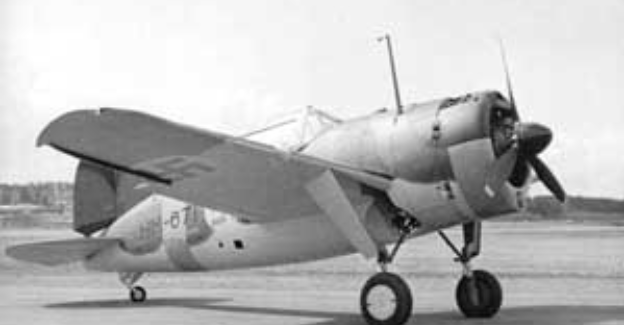
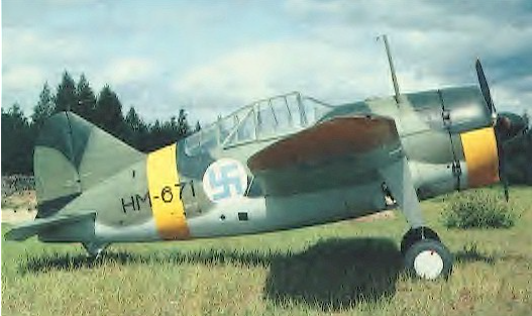
The VL Humu “Whirlwind” was a 1944 Finnish fighter prototype designed by Valtion lentokonetehdas as a local, wood-constructed reproduction of the American Brewster F2A Buffalo (B-239). Designed due to wartime material shortages, it integrated a wooden wing structure and a captured Soviet Shvetsov M-63 radial engine. Only one prototype (HM-671) was produced and flight-tested in August 1944 before the program was cancelled due to the end of the Continuation War and poor flight performance.
In War Thunder, the VL Humu would serve as a unique low-tier premium or event fighter in the Swedish aviation tree (under the Finnish sub-tree line), offering a distinctive hybrid between American airframe design and Soviet engine power.
Origins and Service
During the Continuation War, the Finnish Air Force achieved notable operational success with its fleet of 44 Brewster B-239 fighters. In 1942, facing severe war-related attrition and acute metal shortages, Finnish authorities tasked VL engineers led by Martti Vainio alongside Torsti Verkkola and Arvo Ylinen—with building a domestic copy of the Brewster airframe.
To conserve strategic metals, the design team engineered a wooden wing structure to replace the original metal wings, while keeping the steel frame fuselage, this in turn brough about the elimination of the wing MGs and bomb stations. The aircraft was configured to use captured Soviet flight instruments and a captured 940 hp Shvetsov M-63 9-cylinder radial engine.
VL Humu in 1944
Design Flaws and Flight Testing
The conversion to wooden construction and non-native components introduced severe performance penalties:
Excess Weight: The completed prototype (registration HM-671) ended up 250 kg heavier than calculated.
Altered Balance: Moving fuel tanks from the wings to the rear fuselage drastically shifted the centre of gravity, deteriorating manoeuvrability and handling characteristics.
Underpowered: The M-63 radial engine provided insufficient power for the heavier airframe, capping maximum speed at just 430 km/h.
The Humu took its maiden flight on August 8, 1944. Flight testing totalled 19 hours and 50 minutes. Test pilots and military evaluators concluded that the aircraft was underpowered and completely obsolete compared to contemporary fighter designs.
Cancellation and Preservation
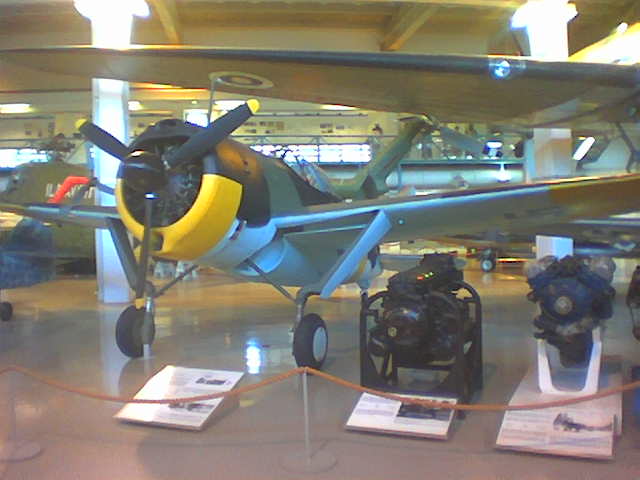
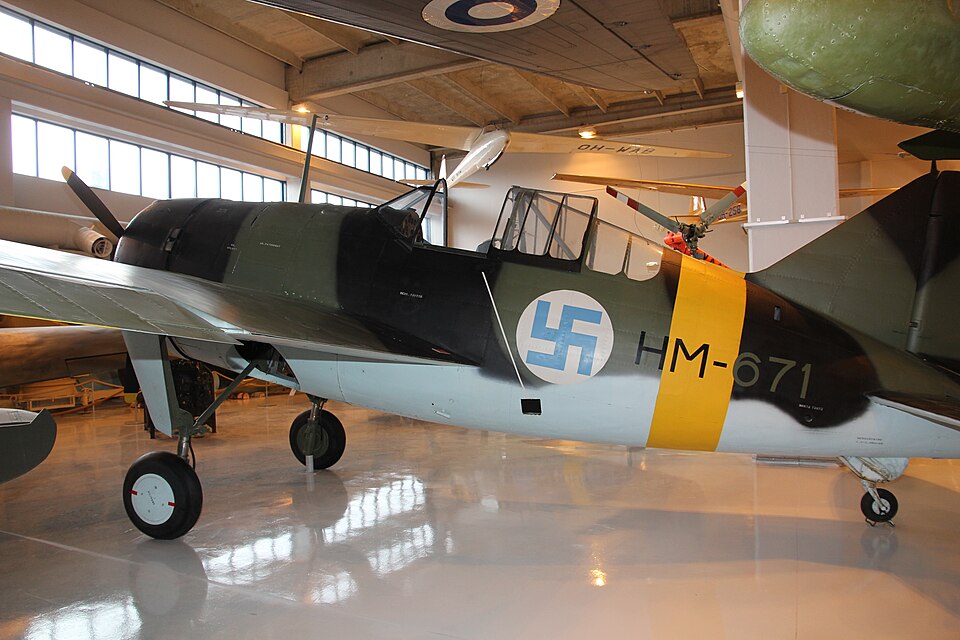
With the conclusion of the Continuation War in September 1944, the project was formally cancelled. Only one prototype was produced. HM-671 was placed into long-term storage in 1945, undergo restoration between 1972 and 1974, and is now preserved on static display at the Central Finland Aviation museum.
VL Humu in the Central Finland Aviation Museum
Historical Significance: Represents Finland’s domestic wartime aviation ingenuity and resourcefulness under extreme material shortages.
Firepower: Armed with two cowl-mounted 12.7 mm heavy machine guns, offering tight group accuracy despite a relatively low overall weight of fire compared to late-war fighters.
Role: Energy fighting and low-tier dogfighting. Works best when retaining speed and engaging turn-fighters from an altitude advantage rather than engaging in prolonged turn fights.
Knowing gaijin they’ll sell it to us in a BP or as a prem, seriously they can’t stand the idea of treating Finland like most trees. If we ever get another Patria I wouldn’t be surprised if it’s another nation getting it as a TT vehicle and then Finland gets a worse version as a premium lol
The Shvetsov M-63 was a 1,100 hp engine, not 940 hp, and flown under the proper settings and given high-octane fuel it gave off more power than the 1,000 hp Wright R-1820-G5.
The Humu had 3 x 12.7 mm LKk/42 MGs, not two. All were in the fuselage. The outer guns held 260 rpg and the inner gun 450 rounds, for a total of 970 x 12.7 mm. The wings could be fitted with one rack each, and each rack could carry a 140 (150?) l drop tank, or alternatively a 50-100 kg bomb.
The gross weight of the aircraft is a bit of a mystery: two different Jukka Raunio sources give 2,536 and 2,563 kg respectively. The latter is probably a typo of the former figure. But then Timo Heinonen & Hannu Valtonen give the aircraft a gross weight of 2,895 kg, which the OP in this thread quotes as the maximum takeoff weight. My understanding is that the final aircraft weighed around 2,536 kg.
430 kmh as the top speed isn’t plausible given that the heavier Brewster 239 with a weaker engine could push 495 kmh at military power at around 5,200 m. The Humu could likely have reached around 520 kmh, especially if the engine was new. Again the initial problems the Finns had with the M-63 frequently giving off less power than the G5 was due to improper settings and a lack of high-octane fuel. Once they got documentation on the engine and began adding ethanol to their fuel, the M-63 consistently gave off more power than the G5.
Sources:
Jukka Raunio (2017): Brewster: Taivaan helmi vai maailman huonoin?
Jukka Raunio (2007): Valtion Lentokonetehtaan Historia: Osa 2
Timo Heinonen, Hannu Valtonen (2010): Albatrosista Pilatukseen
Brewster speed table and the sources within (BW-366 flight test data 20.5.1940 & BAC Report 350)
The Finnish Wiki article on the VL Humu.
Thanks for the additional information. When I originally did this, it was with whatever information I had on hand, i.e whatever the English side of the Internet had available and most of that was incomplete, I always knew there was other information out there like all military vehicles, but I didn’t have acess to Finnish sources at the time.
More information is always helpful within the matter. I just wanted a suggestion out there to highlight a little part of Finnish aviation history.
Understood, and I don’t blame you for any errors. Much of the “information” on the Internet and in the literature on the Brewster F2A in all its different iterations is wrong, including (and especially) in the spec department. I’m a long-time Brewster enthusiast and not really even a War Thunder guy; I returned to it and played a few rounds just to be able to go around and comment on the threads on the aircraft on this forum.
I agree with this.
Book VL Myrsky Osa 1: Kehitys ja käyttö by Reino Myllymäki briefly goes through the VL Humu project as well and I can find much of the same information there; 3 x LKk MGs, 1 100 hp M-63 engine, and max speed with the improperly set M-63 (915 hp) on the test bed Brewster with Humu wings already reaching 426 km/h
+1, I wait for days when Finnish aircrafts get some proper representation, especially WW2 period ones (like re-armed/re-engined H-75s, M.S.410s and a few others)
Somewhat unrelated to the Humu conversation, but Myllymäki also repeats the age-old myth of the Brewster 239’s R-1820-G5 being a 950 hp engine. 950 hp was just the engine’s take-off rating; the actual max. the engine could do was 1,000 hp, the engine’s military rating. In other words it was a 1,000 hp engine.
Regarding Finnish Brewster test flight data, one thing to keep in mind with it is that the speeds weren’t, at least to my knowledge, measured at full power, but rather at cruise power. Aside from power, manifold pressure and altitude, engine wear and sub-standard (in this case Soviet) replacement parts causing a decrease in engine power, dents in the airframe causing air resistance, as well as air temperature, humidity and air pressure, are all factors that must be considered when it comes to measuring the top speed of an aircraft. A factory-new aircraft with a factory-new engine is typically capable of considerably faster speeds than one that’s seen combat and a number of repairs over the course of several years.