- Yes
- No


The Humber AC Mk IV. ( 2 pdr.) is a unique Greek modification of the Humber AC Mk IV that replace the Μ6 (37mm) gun that was the standard with a Ordnance QF 2-pounder (40mm) that can also be found on the Marmon-Herrington Mk IV that also served in the Greek and Cypriot military.
History
The Humber Armored Car
In the desperate months following the fall of France in 1940, British forces faced a severe shortage of armoured vehicles after the evacuation at Dunkirk. While existing designs like the Guy Armoured Car showed promise, production bottlenecks at Guy Motors forced the War Office to seek alternatives. The Rootes Group stepped in, leading to the rapid development of what became one of the most successful and widely produced British armoured cars of the conflict — the Humber.
Engineers at Karrier (part of the Rootes Group) adapted the proven chassis of the KT 4 artillery tractor, already in production for export. They combined it with the armoured hull and turret from the Guy design, relocating the engine to the rear for better balance. The result was a practical 4x4 vehicle that could be manufactured quickly using existing components. To avoid confusion with the popular Universal Carrier, the new vehicle was named after Humber Limited, another Rootes company, even though much of the work occurred at Karrier’s Luton facility.
The Humber entered production in 1941 as a compact, rugged reconnaissance vehicle weighing around 6.3 tonnes. It featured a welded armoured hull with up to 21 mm of protection, leaf-spring suspension (with hydraulic dampers at the rear), and a reliable Rootes 6-cylinder petrol engine producing about 90 horsepower. This gave the vehicle a top speed of roughly 50 mph (80 km/h) and a useful operational range. The driver sat in the forward compartment with a protected vision flap and Triplex bulletproof glass, while the fighting compartment housed the turret. Early models relied on a pair of Besa machine guns (15 mm and 7.92 mm) for firepower.
- Evolution of the Marks
Mark I: The initial version closely mirrored the Guy Armoured Car. Around 300 were built before improvements were introduced. It carried a three-man crew (driver, gunner, and commander/wireless operator).
Mark II: This variant refined the hull with a redesigned front glacis plate for the driver’s position and improved louvred armour over the rear radiator. These changes enhanced protection and practicality without major disruption to production.
Mark III: Introduced a significantly larger turret with sloping sides that allowed space for a fourth crew member dedicated to wireless duties. This eased the commander’s workload and improved combat effectiveness. Roughly 1,650 Mark IIIs were produced.
Mark IV: The final and most numerous major version swapped the 15 mm Besa for the more potent American 37 mm M5/M6 gun. The larger weapon increased anti-armour capability but required reducing the turret crew back to three. Approximately 2,000 Mark IVs were built, making it the dominant variant. Production of all Humber armoured cars eventually reached around 5,400 units by 1945.
- Service Record and Legacy
Humbers first saw action in North Africa in late 1941 and proved versatile across multiple theatres, including Italy, North-West Europe, and the Far East. They excelled in reconnaissance, flank security, and light combat roles, offering a good balance of mobility, protection, and firepower for their class. Commonwealth and exiled forces operated them extensively, and Canadian factories even produced a related variant called the Fox using local components.
After the war, many Humbers were exported or transferred to allied nations. Some remained in service into the early 1960s, a testament to the soundness of the original design born from wartime necessity. Although later vehicles like the Daimler and Coventry offered certain advantages, the Humber’s sheer numbers and reliability made it a cornerstone of British and Commonwealth armoured reconnaissance throughout the conflict and beyond.
Its straightforward engineering — based on proven commercial and military components — allowed rapid scaling of production at a critical time. Today, surviving examples serve as reminders of Britain’s innovative industrial response to the challenges of total war.
The Humber Mk.4 in Greek service
The Hellenic Army acquired a relatively small number of Humber Mk IV armoured cars after World War II, primarily from surplus British stocks left in Greece. British units, including the 46th Royal Tank Regiment (46 RTR) operating under the 23rd Armoured Brigade, used Humbers in Greece during the later stages of the war and the immediate post-liberation period (notably in Athens in late 1944–early 1945). As British forces withdrew in 1945, some of this equipment was sold or transferred locally, and the Greek Army pressed a modest quantity into service during the Greek Civil War (1946–1949).
Only a handful of Humbers operated with Greek forces compared to more common types like the Marmon-Herrington series. They represented a minor but interesting footnote in Hellenic armoured vehicle history — rare British leftovers adapted to local conditions. No large-scale standardised fleet existed, and most were phased out relatively quickly after the Civil War as newer equipment became available.
Greek Humbers served in several roles:
- Reconnaissance regiments (Συντάγματα Αναγνωρίσεως)
- Security battalions protecting lines of communication — sometimes mounted on railway flatcars for armoured train duties
- National Guard units
A few vehicles ended their careers as static pillboxes or were scrapped after the conflict.
The unique Greek modification
- The 37 mm gun was replaced with a British Ordnance QF 2-pounder (40 mm) gun — the same weapon used on the South African Marmon-Herrington Mk IVF armoured car.
- The turret mantlet and secondary armament were altered to resemble the Marmon-Herrington configuration more closely, possibly including a .30-cal Browning M1919A4 machine gun.
- An additional M1919A4 was fitted on the turret roof for anti-aircraft or suppressive fire.
These changes are documented in a low-resolution parade photo (possibly in Volos or another coastal town) showing at least two or three modified Humbers. The modifications reflect the Greek Army’s pragmatic “make-do-and-mend” approach, reusing available parts from other armoured cars in their inventory.
Firepower
Main armament: Ordnance QF 2-pounder (40 mm) gun
Secondary armament: Browning Μ1919Α4 (7,62mm) coaxial, and Browning Μ1919Α4 (7,62mm) for anti air preposes
The coaxial machine gun (normally a 7.92-millimeter BESA to the left of the main gun) is not visible, so we can surmise that it either does not exist at all or has been replaced by an American-made Browning M1919A4 (7.62 mm/0.30 inches) mounted to the right of the main gun. This assumption is further supported by the replacement of the turret shield with a design featuring side protective flaps, a configuration that bears similarities to that of the Marmon–Herrington Mk IVF turret. The similarities to the South African-built tank do not end there, as another M1919A4 is clearly visible on the turret roof, turned (for the parade) to the right, just as on the M-H Mk IVF. Unfortunately, the poor quality of the photograph, combined with the presence of the attachments for extricating vehicles from soft ground (sand channels) at the front, makes it impossible to make out their markings beyond the national insignia on the sides of the turrets and, therefore, to draw conclusions about the formation to which they belong.
Protection
15mm all around
Specifications
- Length: 4.61 m
- Width: 2.21 m
- Height: 2.39 m
- Weight: 7.1 t
- Crew: 3 (Driver, Gunner, and Commander)
Mobility
Engine: Rootes 6-cylinder petrol engine
Horsepower: 90 bhp
Top Speed: 80 km/h
Reverse Speed: Approx. 13 km/h
Suspension Wheel 4x4
Power/weight 18 hp/tonne
Images
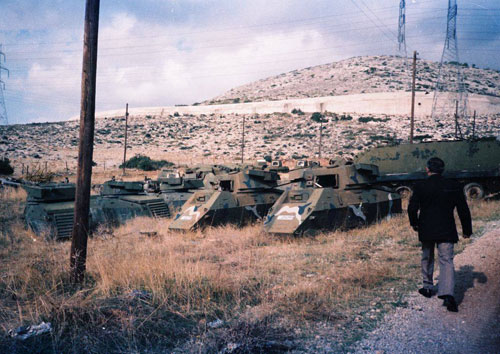
In a junkyard in 1984.
unfortunately they aren’t a lot of pictures