- Yes
- No
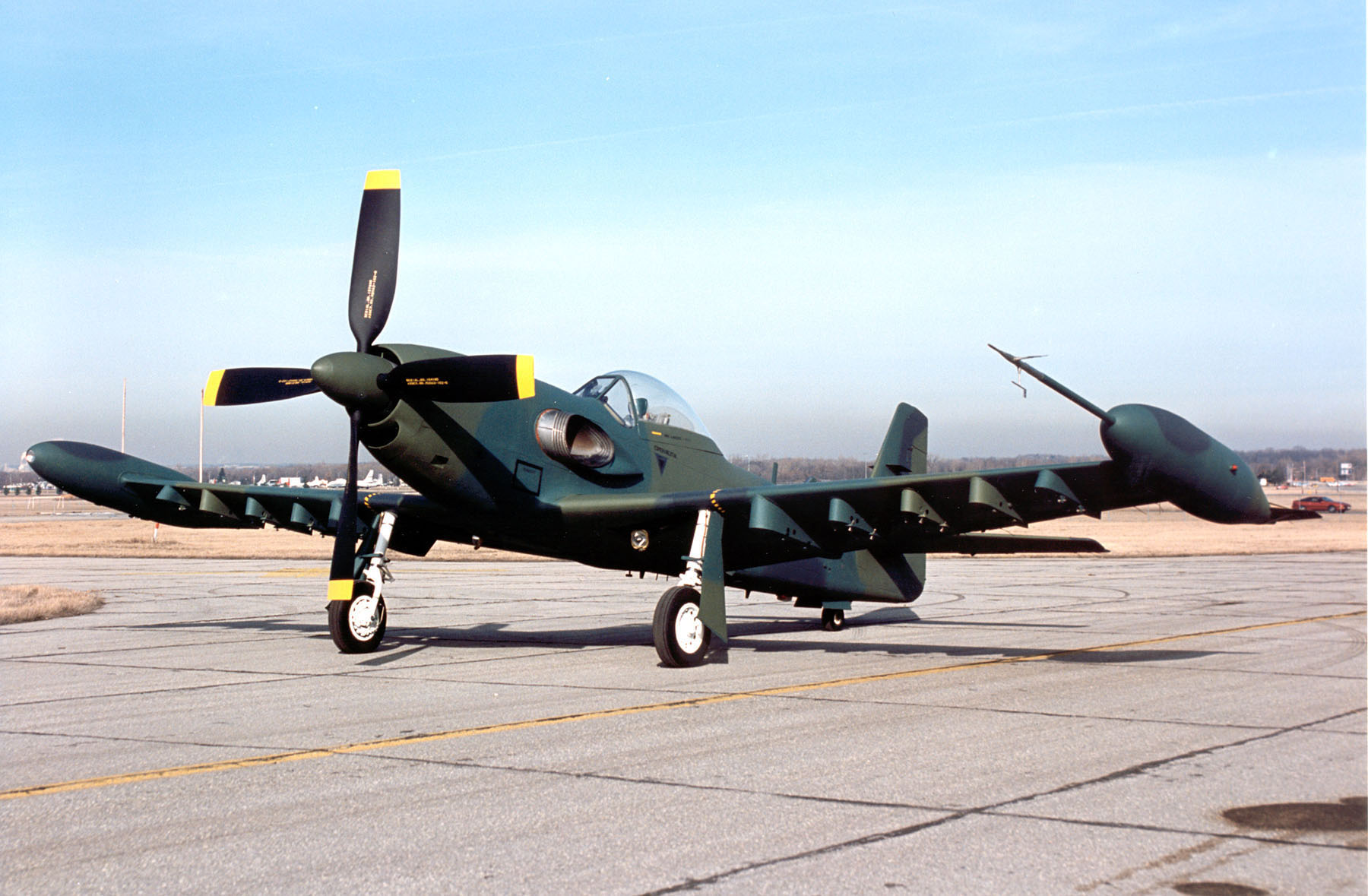
PA-48 during US Air Force trials (source: File:Piper PA48 Enforcer USAF.jpg - Wikimedia Commons)
TL;DR: prototype attacker based on the P-51 airframe and powered by a turboprop engine.
The Piper PA-48 Enforcer was a light attacker/counter-insurgency aircraft developed by David Lindsay and Piper Aircraft in the 1970s/80s. Though appearing somewhat similar to the P-51 Mustang it was developed from, it had a slightly larger and strengthened airframe and a much more powerful Honeywell (formerly Lycoming) YT55-L-9 turboprop. It could carry a heavy load of weapons on its 10 hardpoints, varying from the 30 mm GAU-13/A rotary cannon to 2.5 tons of bombs. Despite performing well in flight tests, the US Air Force believed it was too weak for the Cold War battlefield and never purchased the Enforcer.
History
In 1957, David Lindsay founded the Cavalier Aircraft Corporation to refurbish P-51 Mustangs for civilian use. In 1967, Cavalier was contracted by the US Air Force to produce some military Mustangs for export. These were based on the civilian Cavalier Mustangs but were optimised for ground attack. The first generation, known as the F-51D, was exported to Bolivia while the second generation, known as the Cavalier Mustang II, was sold to El Salvador and Indonesia. Around the same time, Lindsay had the idea of mounting a turboprop on a Cavalier Mustang for extra power to allow greater flight performance and weaponry load. He experimentally mounted a Rolls-Royce Dart 510 turboprop on a P-51 and called it the Turbo Mustang III (he originally wanted to use a Lycoming T55 but couldn’t obtain one). However, Lindsay knew that his small company didn’t have the capacity to produce such an aircraft in quantity or compete for a US Air Force contract, so in 1970/71 he sold the design to Piper Aircraft, closed down his company, and joined Piper as an advisor to continue participating in the project.
Piper started by equipping an F-51D and a twin-seat TF-51D with the Lycoming YT55-L-9 turboprop that Lindsay originally wanted. These two aircraft were given the name “Enforcer” and first flew in April 1971. At this time, experience from the Vietnam War prompted the US Air Force to consider purchasing some low-cost propellor CAS planes both for allies under the Mutual Assistance Program and for their own use as counter-insurgency aircraft. Therefore, the PAVE COIN program was initiated. Piper saw the chance and entered the Enforcer into the competition. While one of the prototypes crashed, the other was test-flown by USAF pilots. However, the Air Force was already losing interest as the Vietnam War wound down and their attention shifted towards combatting Soviet forces in Europe, so the program was cancelled.
Piper was not deterred, and they continued to lobby Congress and pressure the Air Force to reevaluate their plane. Finally, in either 1979 or 1981, they were given a $12 million grant to produce two new prototypes for evaluation, which would be given the company designation PA-48 and inherit the same Enforcer nickname. While still powered by the T55, the airframe was modified and only shared 10% parts with the old Enforcer and other Mustangs. The internal machine guns were removed as it would carry two GAU-13/A pods for strafing. It had 10 hardpoints that could carry a wide variety of other munitions. Top speed was slower than the original Mustang due to the inefficient propellor, but it had much better climb and load-carrying performance. The PA-48 made its first flight on 9 April 1983.
Forced by Congress to evaluate the aircraft, the US Air Force was never really enthusiastic about the project. The A-10, which the Air Force already had large numbers in service, outperformed the PA-48 in every aspect, and it would be laughable to send what is essentially a World War II aircraft against the Soviet hordes in Europe. Therefore, despite performing well in the 1983-84 flight tests, it was never purchased and didn’t even receive a USAF designation or serial number. The two surviving prototypes now live at the Air Force Flight Test Museum and the Pima Air and Space Museum.
Design and specifications
General characteristics:
- Crew: 1
- Wingspan (including tip tanks): 12.60 m
- Length: 10.41 m
- Height: 2.76 m
- Wing area: 22.76 m²
- Empty weight: 3,266 kg
- Gross weight (pilot and armour): 3,576 kg
- Maximum takeoff weight: 6,350 kg
- Internal fuel capacity: 1,605 L, fuel tanks self-sealing and foam-protected
- Engine: 1x Lycoming YT55-L-9 turboprop, 2,445 hp
- Armour: ceramic fibreglass composite armour surrounding engine and pilot, .50 cal/14.5 mm HMG proof, see diagrams for details
Performance:
- Maximum speed at 4,575 m, maximum takeoff weight: 300 kt (556 km/h)
- Never-exceed speed: 350 kt (648 km/h)
- Maximum climb rate at sea level, MTOW: 12.7 m/s
- Service ceiling, maximum takeoff weight: 7,620 m
- Combat radius with 2x 30 mm gun pods: 400 nm (740 km)
Armament:
- 10 hardpoints (n.b. While all other sources say 10 and images also show 10 pylons, Jane’s only says 6, with 907 kg capacity on the inner pylons and 395 kg capacity on the two outer pylons, and a maximum carrying capacity of 2,576 kg):
- 2x 30 mm GAU-13/A gun pods
- Mark 82 Snakeye
- CBU-58A cluster bomb
- Mark 20 Rockeye cluster bomb
- CRV7 2.75’’ rockets
Pictures and diagrams
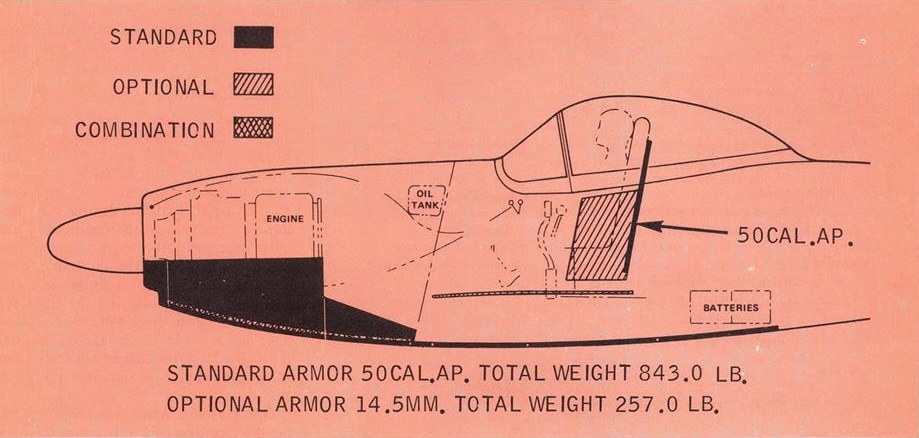
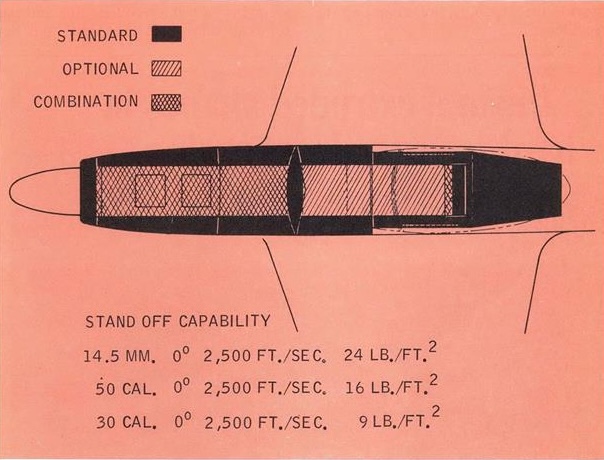
Diagrams of armour layout (source: Robinson)
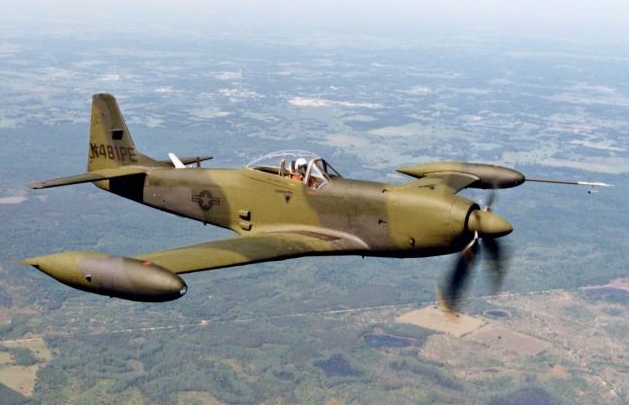
PA-48 in flight (source: File:Bilstein 00946 Piper PA-48 Enforcer N481PE.jpg - Wikimedia Commons)
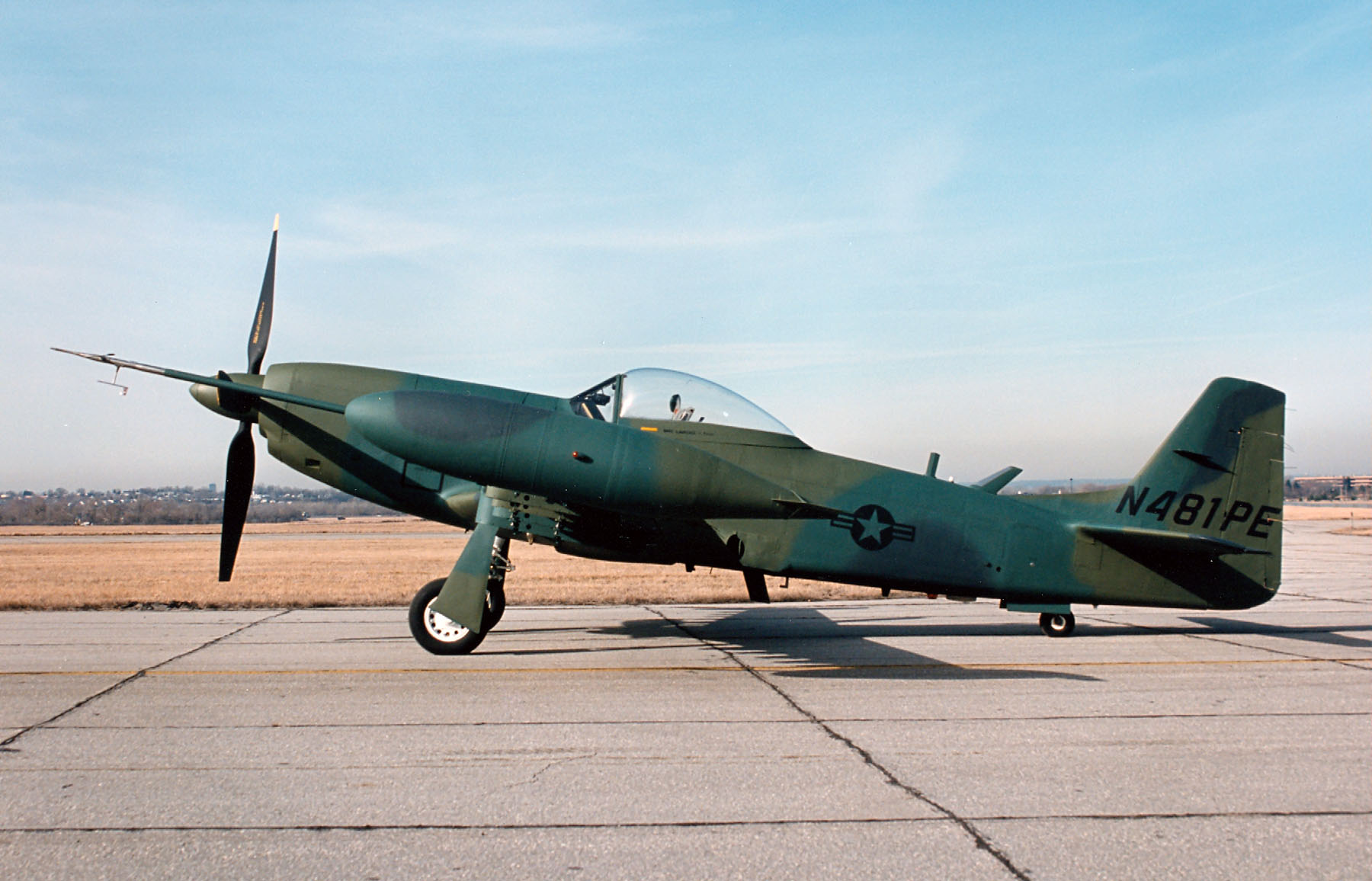
Side view of the PA-48 (source: File:Piper Enforcer.jpg - Wikimedia Commons)

PA-48 at the National Museum of the U.S. Air Force (source: File:Piper Enforcer (museum).jpg - Wikimedia Commons)
Sources
- “Mustang: a living legend” by Michael O’Leary
- “Flight Test Program Sought for Enforcer” by Clarence A. Robinson in Aviation Week & Space Technology, August 12, 1974
- “Jane’s all the world’s aircraft, 1984-85” by John W. R. Taylor
- “Jane’s all the world’s aircraft, 1981-82” by John W. R. Taylor
- Piper PA-48 - Pima Air & Space
- The Cub’s Badass Big Brother
- The Piper PA-48 Enforcer; Mustang on Steroids - Forgotten Aircraft - Military Matters
- https://www.nationalmuseum.af.mil/Visit/Museum-Exhibits/Fact-Sheets/Display/Article/195782/1983-piper-pa-48e-enforcer/
- Piper Enforcer



.jpg)